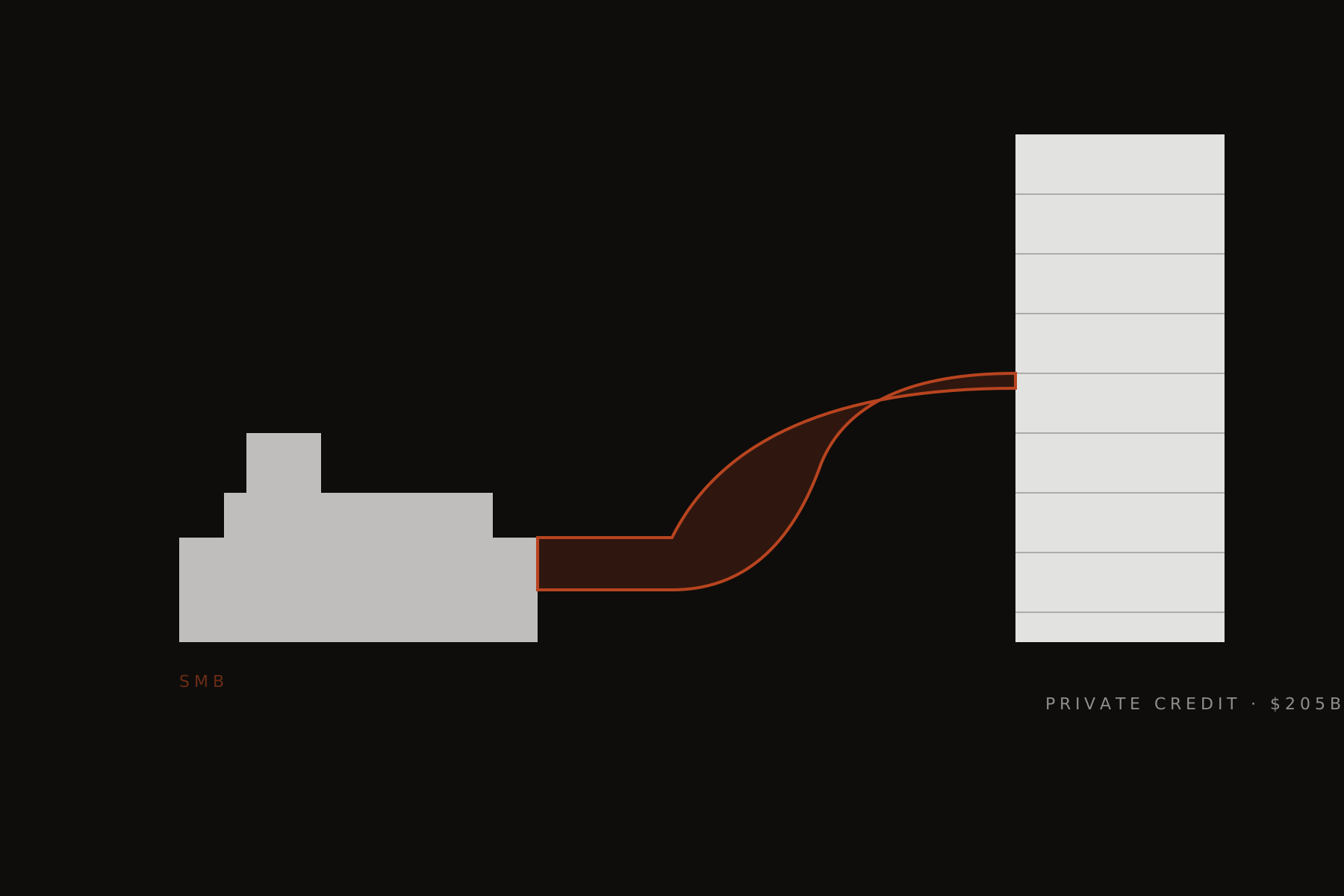
Australian private credit has had a loud decade. The Reserve Bank’s October 2025 Financial Stability Review estimated the domestic private credit market at approximately $205 billion, up from around $70 billion in 2020. That is a tripling in five years, in a jurisdiction whose banking sector had most of the SMB lending market locked up for a generation.
The quieter part of the story is where that capital has been going. A non-trivial slice has pivoted, in the last eighteen months, toward small-business lending. Prospa, Moula, Lumi and Bizcap are the visible names. Behind them are funding-line arrangements with private-credit managers chasing yield that the bank portfolios, after APRA-tightened serviceability rules, no longer produce.
For owner-operators shut out by the Big Four, the non-bank alternatives are real, fast, and expensive.
The rate gap, plainly stated
A secured bank term loan for a small business in 2026 typically clears at 7 to 9 per cent per annum. A Prospa or Bizcap short-term unsecured facility clears at 15 to 30 per cent effective annualised rate, depending on term, collateral and credit quality. For the shortest facilities (30 to 90 days) the factor rate can be higher still.
The rate gap is the product of three real differences.
First, the risk profile. Non-bank lenders are writing loans to businesses the banks have declined. Those declines cluster in construction, hospitality and retail, which are also the sectors most exposed to the 2025-26 insolvency wave.
Second, the cost of funds. The private credit managers funding these lenders expect returns that materially exceed the cash rate. Those returns have to come from somewhere.
Third, the speed. A non-bank lender quoting on a Tuesday for a Friday drawdown is carrying operational cost the bank process does not incur. That cost is part of the rate.
None of that makes the rate wrong. It makes the rate what it is.
The convenience that makes non-bank lending viable for a business that needs cash on Friday is the same convenience that compounds into a serviceability problem by June.
The FY25 reporting
Prospa (ASX: PGL) reported FY25 results showing rising origination volume and average facility size, with the loan book tilting longer and larger. Judo Bank (ASX: JDO), the bank-sector comparator operating in the mid-market SMB segment, recorded its own FY25 growth, though at lower effective rates than the non-bank specialists.
APRA’s quarterly ADI property-exposures statistics through 2024 and 2025 showed business lending to SMEs by the main banks growing below system credit growth. The gap between what SMEs need and what the banks have been willing to lend has widened, and private credit has filled the widening.
ASIC’s Report 806 (2025) flagged transparency and valuation concerns in the private credit funds being marketed to retail and SMSF investors. That is not a small-business-side concern in itself, but it signals that the regulator is watching the pipeline.
For an SMB owner weighing the options
The tactical considerations for a small business choosing between a bank facility, a non-bank facility, or no facility in 2026 are narrower than the product sheets suggest.
- If the borrowing need is capital expenditure with a multi-year payback, the bank option is almost always right. Non-bank facilities should not be used for capex. The term mismatch compounds badly.
- If the borrowing need is working capital through a specific, identified receivable gap of three to six months, the non-bank option can be rational. Specifically: a known contract is landing, the cash is coming, the gap is the problem. In that case the convenience is worth the rate.
- If the borrowing need is to cover a margin shortfall that the business has not otherwise addressed, neither option is right. The non-bank facility will convert a margin problem into a balance-sheet problem.
Most small-business distress in 2026 is not caused by the rate charged on the borrowing. It is caused by borrowing without a credible plan to retire the facility. The non-bank sector, by making the borrowing faster, has not changed that underlying fact. It has only raised the cost of getting it wrong.
The macro question
Whether the private-credit pivot to SMB lending is filling a genuine credit gap or inflating risk is the question the RBA and APRA will wrestle with through 2026-27. The honest answer is that it is doing both.
The businesses that would not have obtained bank finance, and for whom three months of working capital at 22 per cent is the difference between landing a contract and not, are the gap-filling case. The businesses that cannot service bank finance because their underlying margin does not justify it, and are borrowing at non-bank rates to postpone the reckoning, are the risk-inflating case.
The two cases are hard to distinguish on a loan application. The market is distinguishing between them, but with a twelve-to-eighteen-month lag. The lag is where the stress will show up.
For the next several years, the sensible small-business posture is to use the non-bank option where the credit gap is real and the retirement plan is specific, and to stay out of it where either condition is not met. That is not a simple instruction, and it is why the broking profession has, for the first time in a decade, become strategically important to small business.