The legislated start date for payday super is 1 July 2026. From that day, super contributions must be received by the employee’s nominated fund within seven calendar days of payday. The quarterly 28-day window small employers have been using as a working-capital buffer disappears.
Ten weeks out, and most of the small employers I have spoken with have not rebuilt their cash rhythm for the new regime. The checklist that closes that gap is short.
Map the current float
Start with the calendar. Most small employers have, explicitly or otherwise, been running a 30-to-90-day float on super: the accrual period plus the 28-day post-quarter window. Write that number down for your business. It is the number of dollars of working capital you have been using, at zero interest, from the super obligation. From 1 July 2026, that number goes to roughly seven days on average.
For a business paying $48,000 in annual super, the working-capital shift is roughly $6,500 at steady state. For a business paying $240,000 in annual super, the shift is roughly $33,000. Neither is catastrophic. Both need to be sourced.
Audit the pay cycle
If your business pays fortnightly, the payday-super obligation is 26 separate super runs a year. If monthly, 12. If weekly, 52. The operational friction is real. Automation is essential.
Three specific moves to confirm before 1 July:
- Xero / MYOB / QuickBooks auto-super is switched on and tested. Most small employers have this available on their plan. Fewer have tested it end-to-end.
- The fund clearing-house arrangement (usually the ATO’s Small Business Superannuation Clearing House or an aggregator inside the accounting package) is enrolled and credentialed. Enrolment after 1 July is not impossible but it is not the day to be doing it.
- The employee super-choice forms are complete and the fund details accurate. Bouncing a weekly super payment because a fund number is wrong creates remediation work you do not want at any cadence, let alone weekly.
Pre-fund the first two cycles
The single move that most reduces 1 July stress is prefunding. Two pay cycles of super, set aside in a separate operating account before 1 July, gives the business a two-cycle buffer. If the first weekly payment bounces for any reason, there is money to reissue it without delaying other operational payments.
The buffer does not need to be permanent. Once the payday-super rhythm is running smoothly (usually four to six cycles in), the buffer can be unwound. The reason for it is to manage the transition, not the steady state.
Communicate to employees
A brief, written communication to every employee before 1 July, explaining that super will now show up in their fund weekly or fortnightly rather than quarterly, prevents the volume of anxious queries that will otherwise land on the ops manager in July and August. It also avoids the occasional employee who, seeing the first weekly contribution hit their fund, assumes the business has started making bonus payments.
A four-line memo is enough. It is a cheap way to prevent expensive misunderstanding.
Review the wage-bill knock-ons
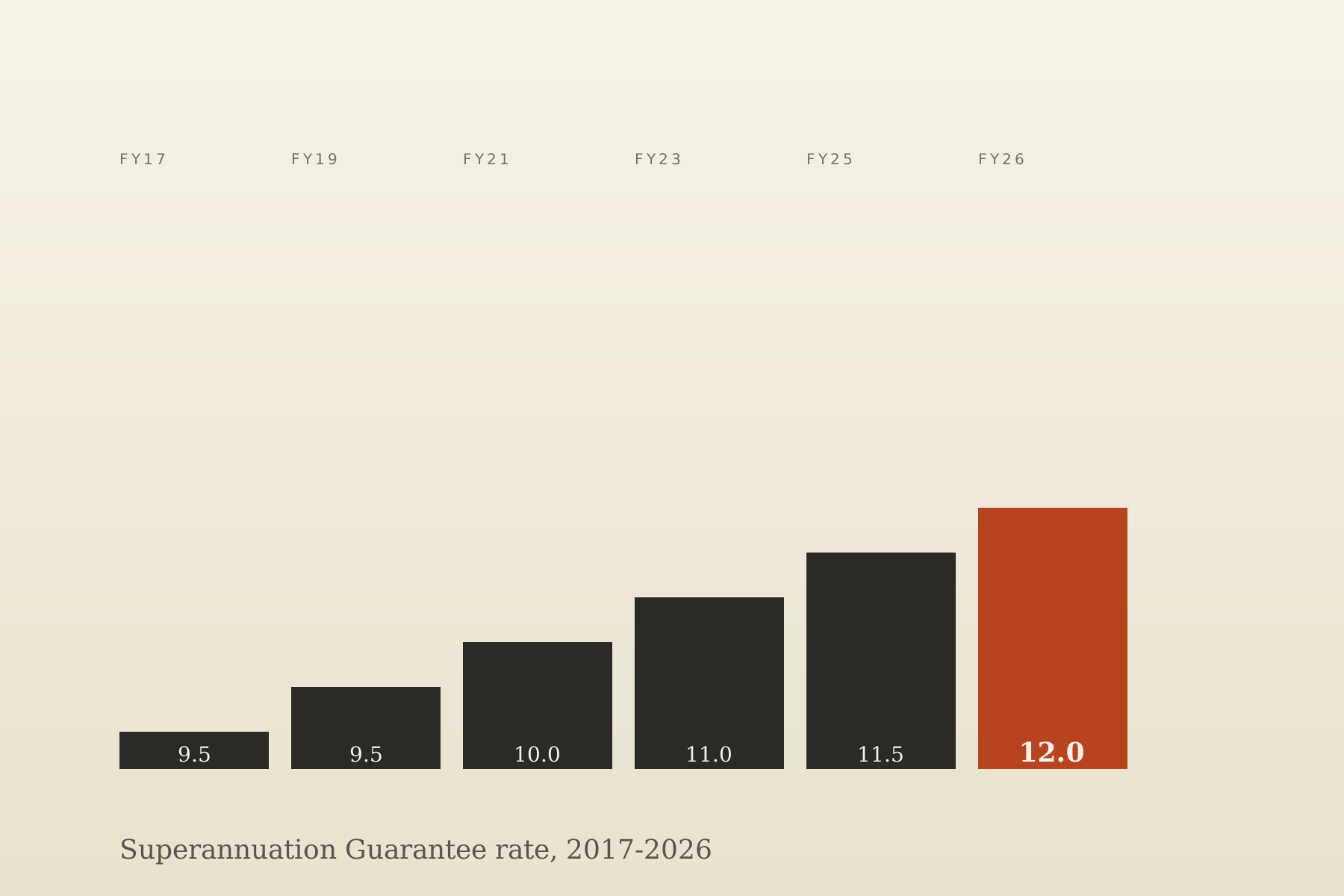
Payday super is not a standalone change. It interacts with the super guarantee now sitting at 12 per cent, the 2025 Fair Work minimum wage rise at 3.5 per cent, and (for some sectors) the April 2026 award-rate adjustments. The aggregate labour-cost trajectory of the business for FY27 should be modelled, once, with all of those compounded into the cash-flow forecast.
For a cafe or trades business with a thirty-person team, the compound of those three adjustments against a flat revenue trajectory is typically 20 to 30 basis points of operating margin. If the business was operating at 6 per cent margin in FY26, it is operating at 5.7 per cent in FY27 on the same revenue. The pricing or productivity response to that reality is better made now than in September.
The one-line summary
Payday super is not expensive. It is operationally exacting. The businesses that are ready on 1 July will be the ones whose bookkeeper spent two hours in May testing the automation, whose operating account carries a two-cycle buffer from mid-June, and whose team has been told once what is about to change.
Ten weeks is enough. Eight weeks is tight. Six weeks is the window where the businesses that have not prepared will start calling their accountant in panic.
The call is cheaper in May.