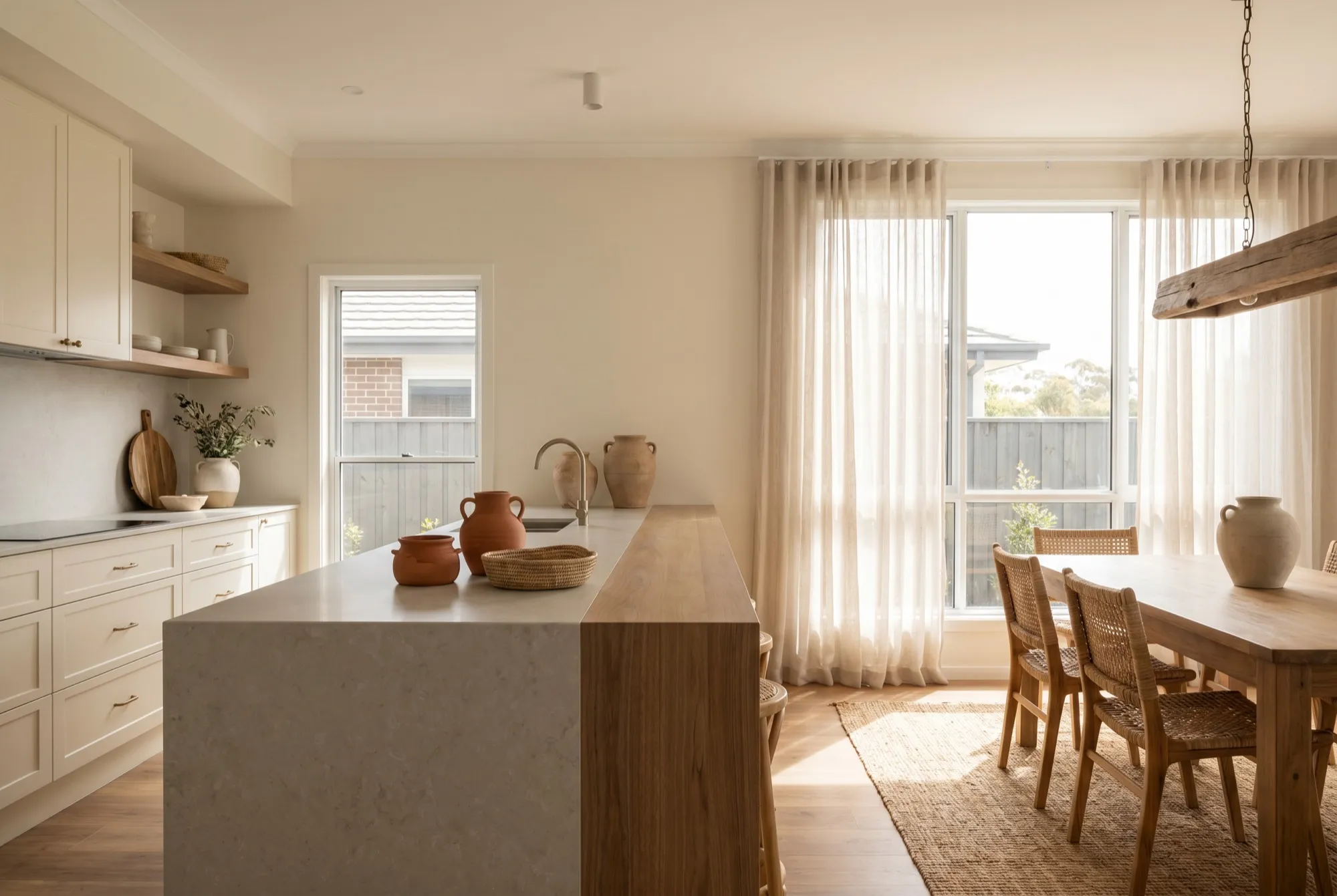
A kitchen renovation in Australia commonly costs somewhere between roughly $10,000 and $80,000 or more, with most jobs landing in a mid-range band of about $25,000 to $45,000 (last checked June 2026). The reason that spread is so wide is simple: a kitchen is less one project than a dozen smaller decisions stacked on top of each other, and each one can quietly nudge the bill up or down by thousands.
So treat any headline figure, including ours, as a starting point rather than a promise. Prices vary widely by scope, cabinetry, benchtop, and appliances, and the only number that genuinely applies to your kitchen is a written quote for your kitchen. Everything below is here to help you read that quote with clear eyes, not to replace it.
What you get at each price tier
The cleanest way to think about cost is in tiers, because they bundle the dozens of small choices into three broad pictures. The boundaries are fuzzy and they overlap, but they map reasonably well to what most Australian homeowners actually spend.
| Tier | Indicative cost range | Roughly what that buys |
|---|---|---|
| Budget | ~$10,000 to $25,000 | Flat-pack cabinetry, laminate benchtop, entry-level appliances, same layout |
| Mid-range | ~$25,000 to $45,000 | Mix of flat-pack and semi-custom, stone-look or engineered benchtop, mid-tier appliances, minor layout tweaks |
| Premium | ~$45,000 to $80,000+ | Custom joinery, stone benchtop, integrated and high-end appliances, reworked layout |
Figures are indicative and hedged, last checked June 2026. Your actual number depends heavily on your kitchen’s size, the materials you choose, and how much you move around, so it can sit well outside these bands.
A budget reno usually means working with what you have: keeping the existing footprint, swapping tired cabinetry for flat-pack units, and dropping in a laminate top. A mid-range job is where most people land when they want a noticeably better kitchen without remortgaging. Premium is custom territory, where the cabinetmaker measures to the millimetre and the appliances cost more than a budget kitchen did all in.
Where the money actually goes
Once you understand the cost drivers, the tier table stops looking like magic and starts looking like maths. Four line items do most of the heavy lifting.
Cabinetry
Cabinetry is almost always the single largest cost in a kitchen renovation. It is also where the flat-pack versus custom decision lives, which we will come back to, because it can shift the total more than any other choice. The more linear metres of cabinets you have, and the more bespoke they are, the more this line grows.
The benchtop
The benchtop is the next big swing, and the material you pick matters enormously. Laminate is the cheapest option and has come a long way in looks. Engineered stone and natural stone cost considerably more, both for the material and the specialist fabrication and installation.
There is a wrinkle here worth flagging. Engineered (artificial) stone benchtops have faced regulatory changes in Australia over silica safety, which can affect what is available and what your fabricator will work with. It is worth asking your supplier directly about current options before you fall in love with a particular slab, because the goalposts have moved in recent years.
Appliances
Appliances are the line you control most directly at the showroom. You can spend a few thousand dollars kitting out a kitchen with solid entry-level gear, or you can spend that on a single integrated fridge. Cooktop, oven, rangehood, dishwasher, and fridge add up fast, and the gap between “good enough” and “magazine cover” is mostly here.
Plumbing, electrical, and layout changes
This is the sneaky one. Any plumbing or electrical changes, or layout changes, add cost on top of the visible materials. Moving the sink, shifting the gas point, or knocking out a wall all bring in licensed trades and, sometimes, building work. The further your new kitchen strays from where the old one sat, the more you pay for the privilege.
Keep the plumbing and the walls where they are, and your budget breathes. Move them, and it sweats.
If you are weighing this kind of structural change, it is worth reading our broader guide to home renovation costs in Australia before you commit, since a kitchen layout change can quickly become a small building project.
Flat-pack versus custom joinery
This single decision sits underneath the whole tier table, so it deserves its own moment.
Flat-pack cabinetry is cheaper than custom joinery, sometimes dramatically so. You order standard-sized modules, and they arrive ready to assemble and install. For a standard rectangular kitchen with no awkward corners, flat-pack can deliver a genuinely good result for a fraction of the custom price, especially if you or a handy friend can handle the assembly.
Custom joinery is built to your exact space by a cabinetmaker. You pay for that precision and flexibility, and it shows in quirky layouts, unusual dimensions, and finishes flat-pack simply cannot match. If your kitchen has odd angles, a sloped ceiling, or you want a specific look down to the handle, custom earns its keep. If it is a tidy box, the case for spending the extra is weaker.
Most mid-range renos blend the two: flat-pack or semi-custom carcasses with a few custom touches where they count. There is no wrong answer, only the one that suits your room and your wallet.
How long a kitchen reno takes
A typical kitchen renovation takes around 3 to 8 weeks, though that depends on the scope and how cleanly the trades line up. A straightforward like-for-like swap sits at the shorter end. A full gut with new layout, custom joinery on a lead time, and stone fabrication can stretch towards the longer end or beyond.
The timeline is rarely one continuous burst of work. There are gaps while cabinetry is manufactured, then a template is taken for the benchtop, then the stone is cut. Plan to live without a working kitchen for a chunk of that window, and set up a temporary kitchenette somewhere unless you fancy several weeks of takeaway.
Getting the right people in the right order is half the battle, which is why it pays to line up a reliable team early. Our guide on how to find a good tradie walks through vetting the people you will trust with the job. When you are ready to price it, you can compare quotes from kitchen renovators and see how the tiers above translate to your actual room.
Budget a contingency, because kitchens hide surprises
If there is one habit that separates a calm reno from a stressful one, it is setting money aside before you start. Kitchens reliably uncover surprises behind the cabinets: old plumbing that needs replacing, wiring that no longer meets standard, water damage, or a floor that is nowhere near level once the units come out.
A sensible contingency is money you hope not to spend and are relieved to have when you do. Pad your budget, treat the buffer as untouchable until something goes wrong, and you remove most of the financial drama from the project. The same logic applies to other wet areas of the home, which is why our bathroom renovation cost guide makes the same plea.
The bottom line
A kitchen renovation in Australia runs roughly $10,000 to $25,000 at the budget end, about $25,000 to $45,000 in the mid-range where most jobs land, and $45,000 to $80,000 or more for premium work (last checked June 2026). Cabinetry is usually your biggest line, the benchtop is your biggest material decision, appliances are where you can splurge or save, and moving plumbing or walls is the quiet budget killer.
Use these tiers to set expectations and to sanity-check what you are told, but do not mistake them for a price. Every kitchen is different, prices move, and the materials market, including engineered stone, keeps shifting. The only real number is a written quote for your kitchen, ideally a few of them side by side, with a contingency tucked behind it for whatever the old cabinets have been hiding.