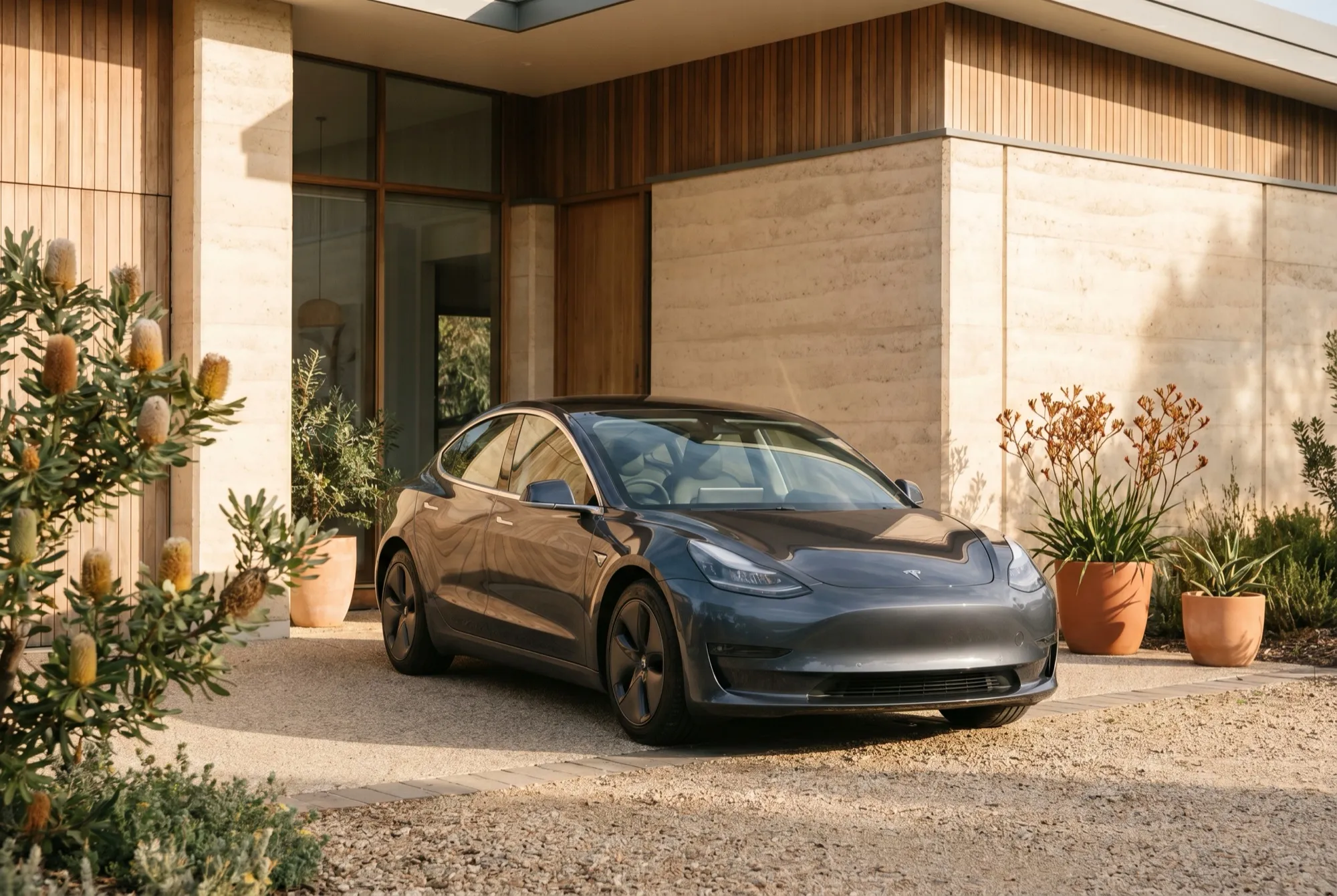
A novated lease is a three-way arrangement between you, your employer and a financier, where your car lease and running costs are paid out of your salary, some of it from pre-tax income, which lowers your taxable income. Whether it is worth it depends almost entirely on the car: for an eligible electric vehicle under the Fringe Benefits Tax exemption it can be very tax-effective, while for a petrol or diesel car the maths is closer and you need to run your own numbers.
That is the short version. The longer version matters, because this is a product where convenience can quietly hide cost.
How a novated lease works
Three parties sign up. You choose the car, the financier owns the lease, and your employer deducts the payments from your pay and sends them on. That is the bit called “novation”: you transfer your lease obligations to your employer for as long as you work there.
The deductions come out of your salary in two slices. Part comes from your pre-tax income, which reduces the salary the Australian Taxation Office sees and therefore the income tax you pay. Part comes from your post-tax income, which exists to offset the Fringe Benefits Tax that would otherwise apply to the benefit your employer is providing. The exact split depends on the car, its price and how the package is structured.
Crucially, a novated lease usually bundles the running costs in too. Fuel or charging, registration, comprehensive insurance, servicing and tyres can all be packaged into one regular deduction. A provider estimates your annual running costs, spreads them across your pay cycles, and reconciles at the end. One payment, most of your car covered. That bundling is convenient, and it is also where margins like to hide.
The EV FBT exemption, and why it changes the maths
Here is the part that has made novated leases popular again. Normally a car provided through salary packaging attracts Fringe Benefits Tax, and that FBT is the reason for the post-tax slice of your deductions. FBT is expensive, and it eats the tax saving.
Eligible electric and low-emissions vehicles are treated differently. Under the FBT exemption, an eligible EV priced under the luxury car tax threshold for fuel-efficient vehicles attracts no Fringe Benefits Tax. Remove the FBT and you remove the post-tax slice, so the whole lease, including running costs, can effectively be paid from pre-tax income.
That is a large difference. For a higher-rate taxpayer, paying for a car and its charging, rego, insurance and servicing from pre-tax dollars can save thousands a year versus buying the same EV on a normal loan with after-tax money. The saving depends on your income, the car’s price and the term, so treat any “save $X” figure a provider quotes as an estimate to be checked, not a promise.
A few guardrails, because the exemption has edges. The car has to be eligible, the price has to sit under the fuel-efficient-vehicle luxury car tax threshold, and the rules can change with policy. The treatment of plug-in hybrids in particular has been tightened over time, so confirm the current position for the specific vehicle before you sign. (Last checked June 2026; thresholds and eligibility are set by the ATO and do move.)
For an eligible EV under the threshold, a novated lease is often the cheapest way to drive it. For a petrol car, treat it as one option among several.
Fees, the residual, and the other catches
No product is free, and the convenience of a novated lease is paid for in a few ways.
First, fees. Salary-packaging providers and financiers charge to set up and administer the lease, often built into your regular payment rather than billed separately, which makes them easy to miss. Ask for them in dollars.
Second, the running-cost budget. Because your fuel, servicing and insurance are estimated upfront, there is a margin in those estimates, and sometimes a markup on the underlying services. If you drive far less than the budget assumes, you can pre-pay for kilometres you never travel, though good providers reconcile and refund the excess.
Third, and most importantly, the residual. At the end you owe a residual or balloon payment: a lump sum to actually own the car, set as a percentage of its original value. The ATO sets minimum residuals by lease term, so a shorter lease carries a higher residual percentage and a longer lease a lower one. You can pay it out, refinance it, or sell the car and settle up, but you cannot ignore it, and any honest comparison has to include it.
Fourth, the job. The lease is novated to your employer, so if you change jobs you generally have to re-novate to the new employer or take over the payments yourself. Between jobs, or if a new employer will not novate, the obligation can land back on you.
Novated lease versus a car loan
So how does it stack up against just borrowing? It depends on the car and your tax rate, but the shape of the trade-off looks like this.
| Feature | Novated lease | Car loan |
|---|---|---|
| Paid from | Salary, partly pre-tax | After-tax income |
| Tax benefit | Yes, largest for an eligible EV under the FBT exemption | None on the loan itself |
| Running costs | Usually bundled in (fuel/charging, rego, insurance, servicing) | You pay each separately |
| Fees | Packaging and financier fees, sometimes hidden in payments | Loan establishment and ongoing fees, usually itemised |
| End of term | Residual or balloon payment owed to own the car | You own the car once it is repaid |
| If you change jobs | Re-novate to new employer or take over payments | No effect; the loan is yours |
| Best suited to | Eligible EVs, salaried employees on higher marginal rates | Anyone, including the self-employed and petrol-car buyers |
Petrol and diesel cars can still work as a novated lease. The pre-tax saving is real and the bundling is convenient. But because the FBT treatment is less favourable than for an eligible EV, the post-tax slice eats more of the benefit, and the gap over a plain car loan narrows. It is worth modelling, not assuming.
The single most useful thing you can do is compare the total cost over the full term, residual included, against the same car on a normal loan or bought with cash, using your own income and kilometres. If you want a starting point, you can compare car finance options and line them up side by side. The lowest monthly payment is rarely the lowest total cost.
Where it sits in your wider money picture
A car is a depreciating asset however you pay for it, so the decision sits alongside the rest of your finances. If you are weighing a novated lease while carrying other debts, it can be worth seeing whether tidying those up first changes the picture; our guide to debt consolidation in Australia covers that.
And if a home is on the horizon, remember that a novated lease is a committed expense lenders will see. A salary-sacrificed car reduces your assessable income and shows up as an ongoing commitment, both of which can affect how much a bank will lend you. If that is you, read how much can I borrow before you sign a multi-year lease, so the two decisions are made together rather than in the wrong order.
The bottom line
A novated lease is a legitimate, often genuinely tax-effective way to pay for a car, and for an eligible electric vehicle under the FBT exemption it is frequently the cheapest way to get into one. For a petrol or diesel car the case is real but narrower, and worth comparing carefully against a plain loan. Either way, the residual, the fees and the job-change risk are the parts that get glossed over, so those are exactly the parts to pin down in dollars before you commit.
This article is general information only and not personal financial, tax or legal advice. Figures and FBT rules described here were last checked in June 2026 and do change; confirm the current position with the ATO and a licensed professional for your own circumstances before acting.