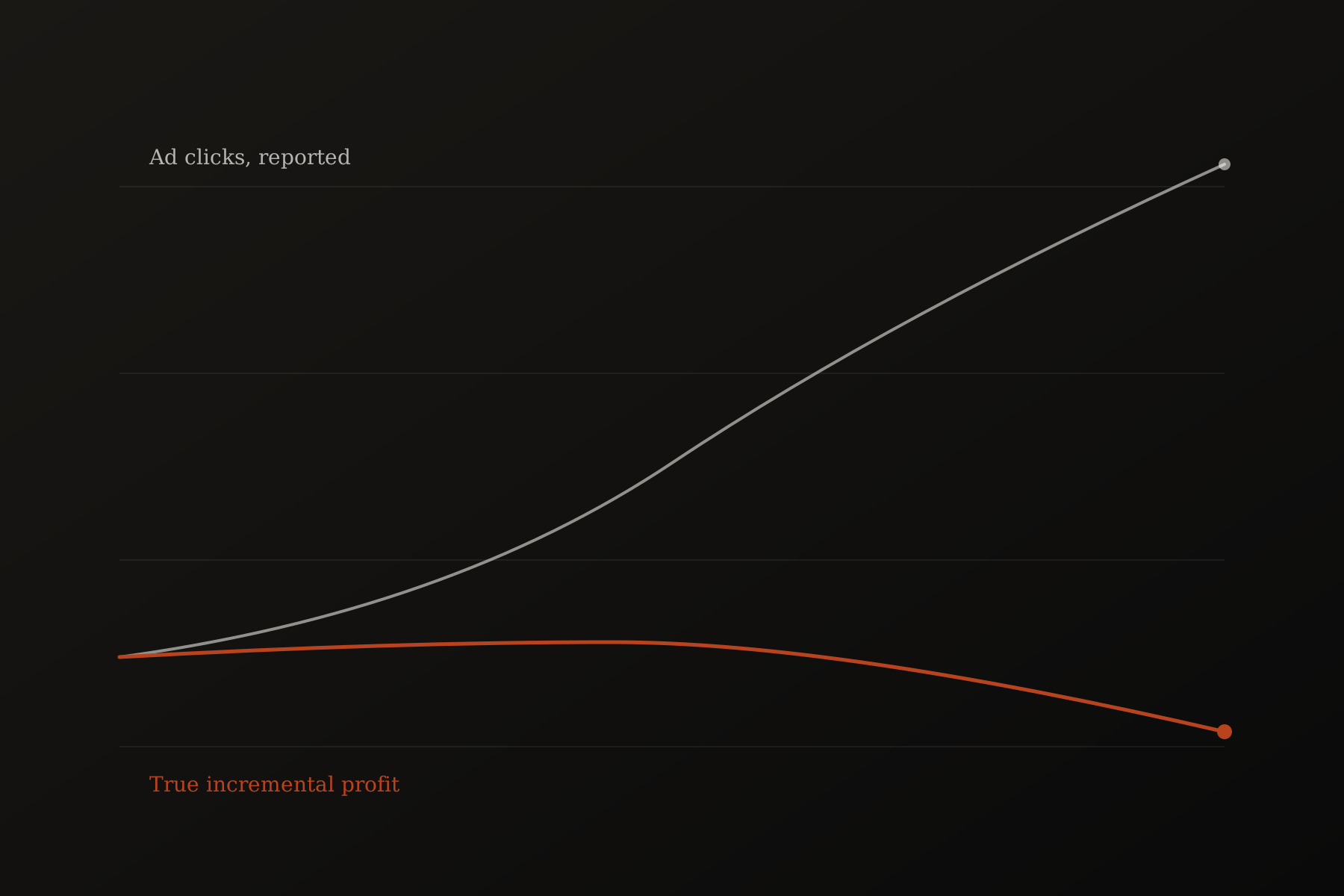
For most of the last decade, the ad platforms told Australian e-commerce and SaaS operators a story. The story was that every sale their Meta or Google campaigns reported was caused by those campaigns, and that the right way to scale was to move the reported return on ad spend (ROAS) number up.
That story stopped being true some time around the 2021 rollout of Apple’s App Tracking Transparency. It has not been repaired since. Meta and Google still report conversions, but they now do so via modelled and probabilistic data rather than deterministic attribution. For an established direct-to-consumer brand running always-on brand and prospecting campaigns, MECLABS and Smart Insights research in 2024-25 concluded that in-platform ROAS was routinely overstating true incremental lift by 20 to 60 per cent.
That is not a rounding error. For a $5 million DTC brand running at a blended 3x reported ROAS, the difference between a true 3x and a true 1.8x is the difference between a profitable business and a subsidy.
The consultancy that does not look at ROAS
Profit Geeks, founded in Sydney, is a small operator in a crowded field. The market for paid-media consultancies is overflowing with agencies that promise higher ROAS, higher click-throughs, and higher reported conversions. What Profit Geeks sells is different.
The pitch, in the firm’s own language, is that it optimises for “PROFIT. Not clicks. Not impressions. Revenue.” The measurable number it reports to clients is not ROAS. It is contribution margin after every cost the ad platform does not model: product cost, shipping, platform fees, returns, the paid media spend itself, and attribution adjustments for paid search on brand terms that would have converted anyway.
On the firm’s own figures, it has lifted average ROAS across its client book by 4.2x, against an influenced revenue figure north of $200 million across seven years. Those are the kinds of numbers an agency prints on a pitch deck. What is interesting about them is that they are the side-effect, not the objective. The objective is further down the P&L.
Three metrics, weekly
The internal operating rhythm I have seen at the best-run AU DTC operators (and which Profit Geeks codifies for its engagements) is a weekly review of three numbers:
- Marketing efficiency ratio (MER). Total revenue divided by total paid media spend. A blended number, not platform-attributed. Trend matters more than absolute level.
- Contribution margin after ads (CMaA). Gross margin minus the ads spend it took to acquire the revenue, expressed as a percentage of revenue. This is the number that predicts whether the business is, in fact, making money this week.
- Incrementality-adjusted ROAS. Reported ROAS discounted for the portion of conversions that would have occurred without the ad. For brand-search campaigns this is the biggest adjustment; for retargeting it is usually second-biggest.
Almost no Australian DTC operator under $10 million of revenue runs the third number. Most do not run the second. The reason is that running them requires accepting that some of the ad spend an operator has been counting as profitable is, in fact, unprofitable.
The transparency move
Profit Geeks’s client model includes something worth flagging for the broader market: clients own every account, every code repository, every dashboard the engagement builds. On departure from the engagement, the client leaves with the work intact and the agency does not hold any of it.
That is not how the agency market usually works. Most paid-media agencies treat the ad accounts, tracking pixels, server-side implementations and reporting dashboards as proprietary, and extract a rent for continuing access. The lock-in that produces is one of the reasons agency churn is lower than it should be, and client satisfaction is lower than it could be.
The agencies that outlast this cycle will be the ones that do not need the lock-in to keep the client. The ones that earn the retention quarter by quarter.
Why this matters for 2026
The broader 2025-26 shift in Australian e-commerce and SaaS is a retreat from growth-at-all-costs and a return to margin discipline. Australia Post’s 2025 eCommerce Industry Report recorded total online purchase volume down roughly 1.2 per cent year on year, with average order value rising, consistent with fewer but higher-intent buyers. That is a market that rewards operators who can measure contribution margin at SKU or customer level and punishes operators who cannot.
The operators who thrive in that market will not necessarily be the ones with the best creative, the lowest CAC, or the highest reported ROAS. They will be the ones who know, on a Wednesday, whether the ad spend they authorised on Monday is going to produce profitable revenue by Friday.
That is not a glamorous playbook. It is also, for the next several years of Australian DTC and SaaS, the only playbook that has a chance of compounding. A consultancy that has built its business around it is, on the evidence, worth knowing about.
The firm limits itself to two new engagements a quarter. On the arithmetic of the market it is quoting against, that is probably the right number.