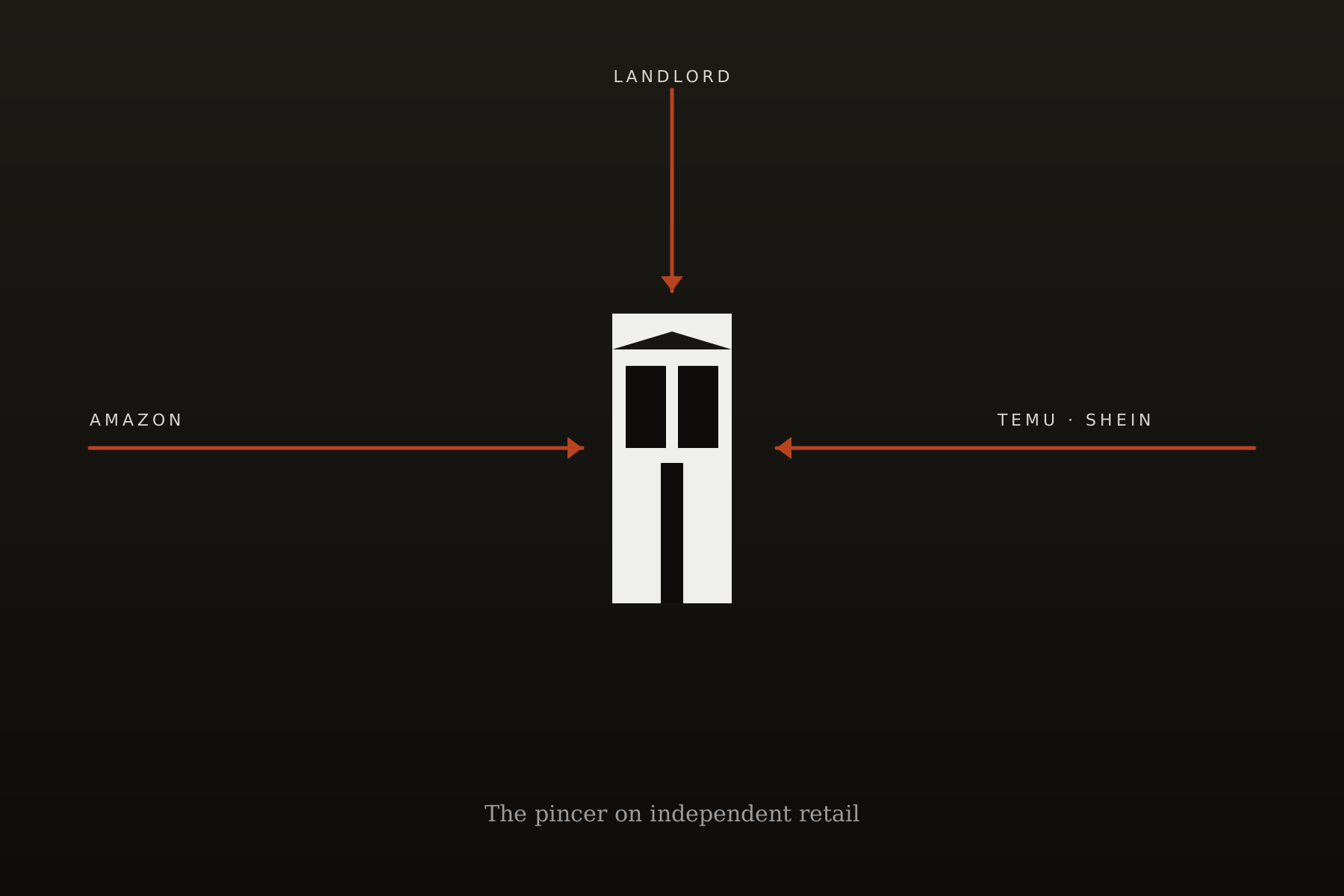
Australian independent retail has had a bad eighteen months. That is not controversial. Retail insolvencies in FY25 exceeded 1,000, up 13% across the first four months of FY26, running roughly 50% above pre-Covid levels. Total business insolvencies were 14,716 in FY25, up 33% year on year.
But “retail is tough” is not a story. The interesting question is the mechanism. What specifically is happening to the dollar that an independent retailer expects to capture when a customer walks through the door?
The short answer is that three actors are pulling on the same dollar, and in most independents’ P&Ls at least one of those pulls is now decisive.
The cross-border cap on price
Temu reached five million Australian shoppers in March 2026, up 17% year on year. Shein reached 2.9 million, up 28%. Amazon added 1.1 million shoppers year on year to 7.9 million. Jarden’s house forecast puts the combined Amazon / Temu / Shein sales in Australia at over $18 billion in 2026, approximately 36% of online retail.
The pricing effect of this is not that these customers stopped shopping at independents. Many of them still do. The effect is that the price anchor for any category these three compete in has reset, and the reset is visible in categories where the independent was, until 2023, still operating at full margin.
A Temu landing page showing a $11 silicone kitchen tool set and a Shein jumper at $18 does not tell a customer what to buy. It tells them what is possible. The independent retailer selling the same category at $34 and $68 respectively is now carrying the gap on their own margin, or closing it and carrying a shorter ticket.
Euromonitor’s Q3 2025 numbers on Amazon’s Australian category penetration make the category-level version of this concrete. Amazon reached 38% of Australian online oral-care sales in the quarter. Woolworths reached 25%. In online laundry care, Amazon’s share moved from 6% in 2022 to over 10% in the first nine months of 2025. Those are categories where the independent was, three years ago, the price-setter. They are now the price-follower, if they are in the category at all.
The category share capture
Temu and Shein cap the price ceiling. Amazon is doing something different, and arguably harder to compete against: it is taking the category leadership position, and with it the customer-acquisition loop.
An independent retailer in 2019 could reasonably expect that a new customer discovering a category (say, oral care) would land in that category through category-general search, and the first several results would be a mix of brand.com pages, category specialists, and a couple of large retailers. The independent, with a well-merchandised store and a local SEO presence, could capture a decent share of that traffic.
In 2026 the first search result for “toothbrush” in Australia is, in most cases, Amazon. The second is also Amazon, at a different SKU. The third is frequently a brand.com page that fulfils via Amazon. The category has become, in the customer’s discovery journey, the name Amazon.
The implication is that customer acquisition for independents has to happen outside the category-search loop. It has to happen through loyalty, local presence, in-store experience, or through a paid channel with terms (and take rates) the independent does not control. Every one of those options is more expensive, per acquired customer, than the 2019 version of the same acquisition.
The rent off the top
The third actor is the landlord. I covered this separately in last week’s piece on CPI-indexed lease clauses: the mechanism there is that independent retailers signed leases in 2021-22 assuming benign inflation, and the clauses have compounded roughly 25% of base rent across those leases in the five years since.
The specific interaction with the retail pincer is that the landlord is not a participant in the pricing conversation. The rent is set by a contract signed before the other two pressures arrived, and it comes off the top of the dollar before any margin question is answered. For an independent paying a rent increment each year that exceeds the growth in their contribution margin, the business is losing money on the lease clause alone.
The CreditorWatch commentary on FY25 retail insolvencies supports this. The insolvencies are not clustered in the businesses with the most aggressive cross-border competitors. They are clustered in the businesses with the least lease flexibility.
What the survivors look like
The independents I have spent the most time with in the past six months, the ones that are not in the insolvency bucket, share three characteristics.
They have moved out of categories where Amazon or Temu have reached double-digit online share. That is not a complete withdrawal from those categories, but it is a decision not to fight for the marginal customer in them.
They have built a direct-customer relationship that is not mediated by category search. Usually through a loyalty program, often through a newsletter, occasionally through an in-store event or local sponsorship. The common theme is that the customer knows who the retailer is by name, not just by category.
They have renegotiated their lease, or moved, or prepared a credible case to the landlord for a variation. The 2026 version of the independent that survives is not the one with the best merchandising. It is the one with the best lease.
That last point surprises operators more than the other two. The pressure they spend the most time thinking about (the cross-border sellers) is the pressure they can least control. The pressure they spend the least time thinking about (the lease) is the one that decides the outcome.
What the policy response should be
This question sits outside my beat, but the shape of the policy response, if one is coming, is reasonably clear from what other comparable jurisdictions have done.
The cross-border pricing pressure is not amenable to direct intervention. The ARA has pointed out, fairly, that Temu and Shein do not contribute to Australian employment the way domestic retail does, and do not face the same governance and regulatory standards. But the options for responding are limited to consumer education, to GST enforcement (in progress, limited), and to product-safety enforcement (where there is real scope).
The rent-and-lease pressure is, by contrast, within reach of reform. The NSW Retail Leases Amendment Bill is the first tranche; the indexation clause itself is the second tranche that has not yet been tabled. If retail policy is going to move in a useful direction, that is where it will move.
The category-leadership question, the Amazon question, is the hardest, because it is an emergent property of the search layer rather than a retail question per se. The honest answer is that independents are going to have to operate for the next several years as though the category-search customer is not available to them.
For the operators still running, the pincer is not going to loosen. The task is to choose which two of the three pulls to hold off, and to accept that the third will take what it takes.