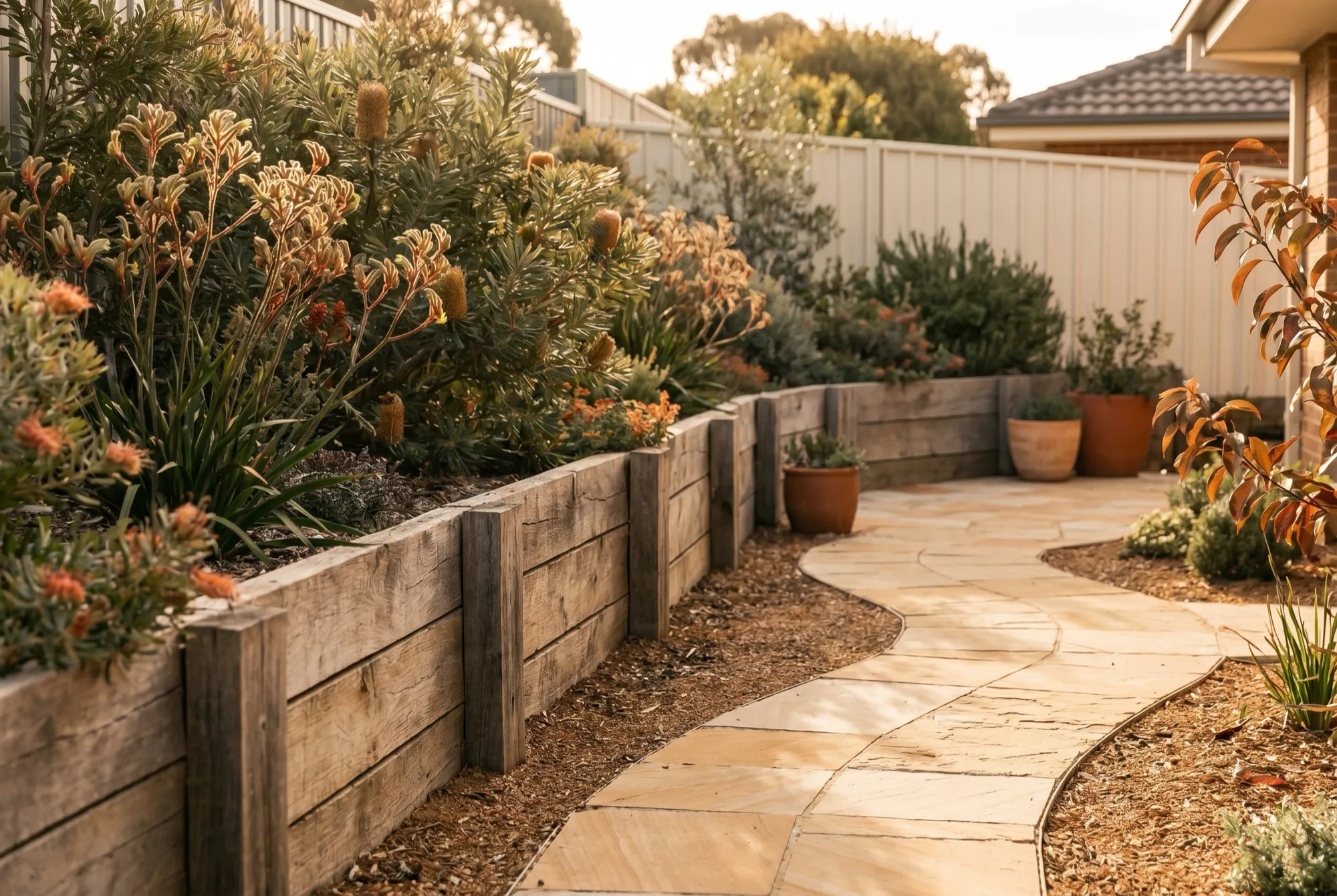
A retaining wall in Australia is usually priced per square metre of wall face, and as a rough guide you are looking at about $200 to $700 plus per square metre, depending on the material and the height. Timber sleepers sit at the cheap end, concrete sleepers and besser block in the middle, and natural stone or rendered concrete at the top.
That is the short version. The longer version is that a retaining wall is one of those jobs where the headline rate tells you surprisingly little, because what you are really paying for is the engineering, the drainage and the dirt behind it. Two walls of the same length and the same material can cost wildly different amounts once you factor in height, site access and what the soil is doing. So treat the numbers below as a starting point for the conversation, not the invoice.
Why retaining walls are priced per square metre
It feels natural to ask “how much per metre of wall”, as you would for a fence. But a retaining wall is fighting gravity across its whole face, so the square metre of the face, which is length multiplied by height, is what actually maps to cost. A 10 metre wall that is half a metre tall is a very different beast to a 10 metre wall that is two metres tall, even though the fence-line length is identical. The taller one holds back roughly four times the dirt and needs the footings, reinforcement and drainage to match.
This is also why you cannot really price a retaining wall off a photo or a hunch. The number that matters lives in the engineering, and the only way to pin it down is a site visit and a quote.
Cost by material
Here is the rough lay of the land for common wall types in Australia. These are supplied and installed ranges per square metre of wall face, last checked June 2026, and they are deliberately wide because that is the honest picture.
| Material | Typical cost (per m² of wall face) | Notes |
|---|---|---|
| Treated timber sleepers | $200 to $350 | Cheapest option, shorter lifespan, good for low garden walls |
| Concrete sleepers (steel posts) | $300 to $550 | Popular all-rounder, strong, low maintenance |
| Besser or core-filled block | $350 to $600 | Solid and durable, usually rendered or capped |
| Interlocking concrete blocks | $350 to $600 | No mortar, tidy finish, good for curves and terraces |
| Rendered concrete or natural stone | $500 to $700+ | The premium end, both for looks and for big structural walls |
A couple of honest caveats. Timber is cheap up front but it does not last forever, so the lifetime cost gap narrows over the years. And the top of that stone and rendered range is open-ended on purpose, because once a wall gets tall or sits on a tricky block, the engineering can push the figure well past $700 per square metre. There is no universal price, which is the whole point.
What actually drives the cost
Five things move the number more than anything else, and the material is only one of them.
Height
Height is the big one. A taller wall holds back more soil, which means deeper footings, more reinforcement and, past a certain point, mandatory engineering. The jump from a knee-high garden edge to a wall you could stand behind is not linear, it is a step change, and your quote will reflect that.
Drainage
Drainage is not optional, and it is not a place to save money. Water building up behind a wall is the single most common reason retaining walls bow, crack and eventually fail. A proper job includes ag pipe, gravel backfill and weep holes so the water has somewhere to go. If a quote looks suspiciously cheap, drainage is often the corner that has been quietly cut.
A retaining wall that cannot drain is a retaining wall on a countdown.
Site access
If the crew can back a truck and a bobcat up to the work, you save money. If everything has to be barrowed by hand through a side gate, down a slope or around the back of the house, labour climbs fast. Sloping, tight or fully landscaped blocks all add to the bill, and they are easy to underestimate from the kerb.
Soil and ground conditions
What is under and behind the wall matters. Reactive clay, sandy soil, rock you have to dig through, or a high water table all change the design and the cost. This ties straight back to the engineering, because the soil is half of what the wall is being designed to hold.
Finish and extras
Capping, rendering, a particular stone, steps, curves, lighting or built-in garden beds all add up. None of it is structural, but it is real money, and it is worth deciding what you actually want before you ask for quotes so you are comparing like with like. If a retaining wall is one line in a larger backyard project, our guide to landscaping cost helps you see where it fits in the bigger budget.
The rules: when you need approval
This is the part people skip and later regret. In most Australian states, a retaining wall over about one metre high needs engineering certification and council approval or a building permit. Some councils set the trigger lower, and walls near a boundary, near a structure, or close to easements and drains can need approval even when they are under a metre.
The exact threshold varies by state and council, so check your local rules before anyone starts digging. It is not red tape for its own sake. An engineered, certified wall is one that has been designed to actually hold, and it is the difference between a structure that lasts decades and one that becomes your neighbour’s problem after the first big wet. Skipping engineering, like skipping drainage, is one of the main ways retaining walls fail.
Getting accurate quotes
Because the number swings so hard on height, drainage, access and soil, the only real figure is a written quote from someone who has stood on your block and looked at it. Aim for two or three quotes from licensed landscapers or builders, and when you compare them, read past the bottom line. Check that drainage is specced, that engineering is included where it is needed, and that you are comparing the same material and the same finish.
A good way to line up several local quotes at once is Need a Tradie, which connects you with licensed landscapers and builders in your area. If you want to vet whoever turns up before you sign anything, our guide on how to find a good tradie walks through the questions worth asking.
One last sanity check. Cheap quotes that gloss over drainage or engineering are not actually cheap, they are deferred. A wall that fails has to be rebuilt, often after it has taken a fence, a path or a slab down with it, and that bill makes the original saving look very small.
The bottom line
Budget around $200 to $700 plus per square metre of wall face for a retaining wall in Australia, with timber at the low end and stone or rendered concrete at the top, all last checked June 2026. But the material is only one lever. Height, drainage, site access and soil do most of the heavy lifting on price, and any wall over about a metre will usually need engineering and council sign-off, so check your local rules early. The honest takeaway is that there is no single price for a retaining wall. The only number you can rely on is a written quote from a licensed pro who has seen your site, and the worst place to economise is on the drainage and engineering that keep the thing standing.