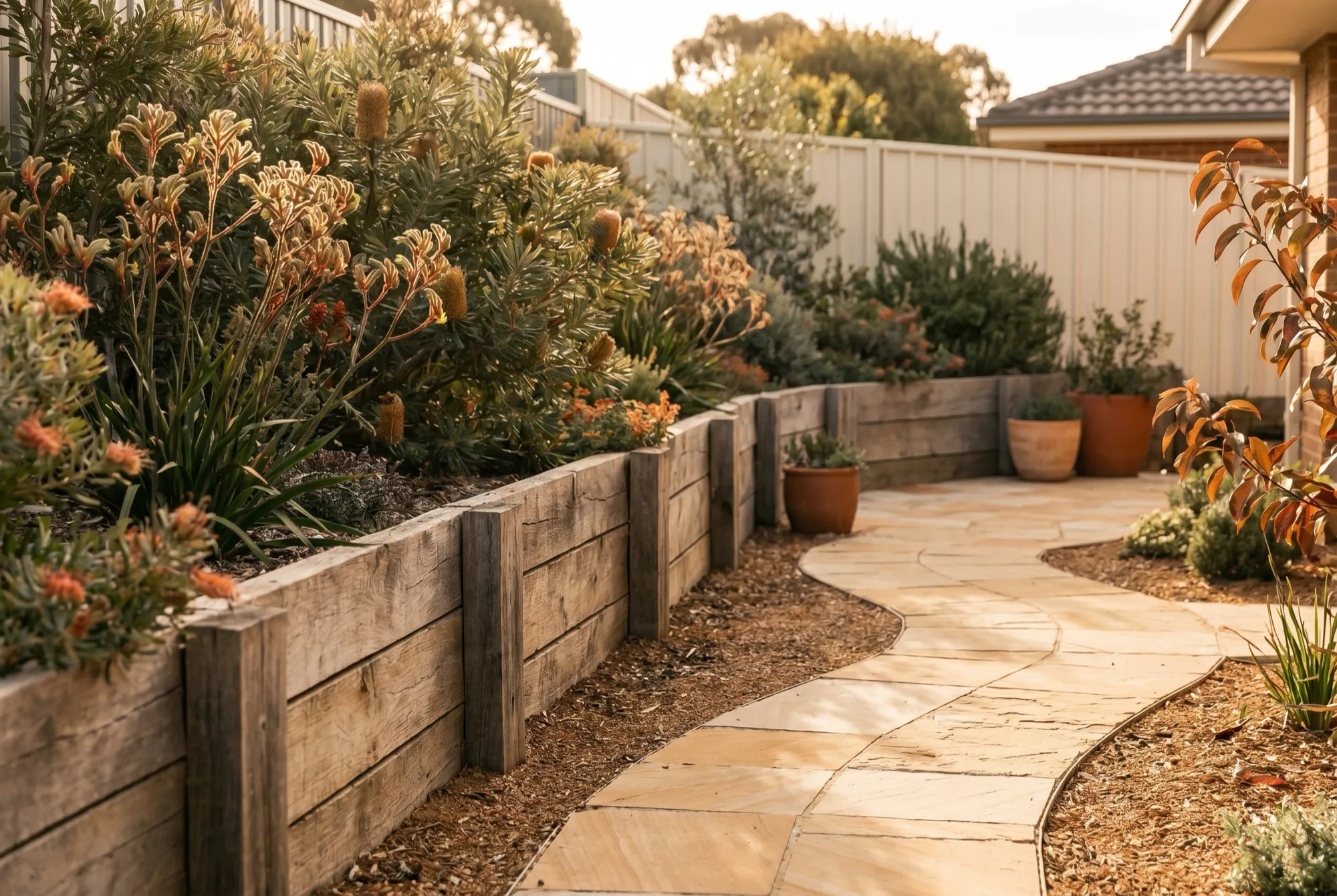
Landscaping in Australia typically costs anywhere from a few thousand dollars for a basic tidy-up to around $15,000 to $50,000 or more for a full backyard makeover, with premium designed gardens running well beyond that. Where you land inside that range depends almost entirely on how much hard landscaping (paving, walls, decks) you want, not on how many plants you put in.
That is the short version. The longer version is more useful, because “landscaping” is one of those words that covers everything from a bloke with a trailer-load of mulch to a six-figure outdoor renovation with a designer, a draftsperson and a small army of trades. Prices below were last checked June 2026, and they move with materials, labour and the state of your site, so treat them as ballpark figures rather than gospel. The only number that is genuinely real is the one written on a quote for your actual yard.
So what does “landscaping” actually include?
It helps to split landscaping into two camps, because they behave very differently on a budget.
Soft landscaping is the living, growing stuff: turf, garden beds, plants, mulch, topsoil and irrigation. It is generally the cheaper half. Turf and mulch are relatively quick to lay, plants can be scaled up or down to suit the wallet, and you can often do a fair bit of it yourself if you are handy and patient.
Hard landscaping is the built stuff: paving, retaining walls, decking, driveways, paths, pergolas, outdoor kitchens and other structures. This is where the money goes. Hard landscaping involves excavation, materials by the tonne, skilled trades and sometimes engineering or council approval. A single retaining wall on a sloping block can cost more than an entire yard’s worth of plants and turf combined.
Once you understand that split, the wild price range stops looking so mysterious. A garden that is 80% lawn and a few beds will sit at the cheap end. A garden full of paved entertaining areas, a deck and a couple of walls will sit at the expensive end, even if the two yards are the same size.
The 5 to 10% rule of thumb
A common starting point in the industry is to budget somewhere around 5% to 10% of your property’s value for a complete landscaping project. On a million-dollar home, that is roughly $50,000 to $100,000 for the full treatment, front and back.
Now, before you spit out your coffee: this is a rule of thumb, not a law. It is a sanity check, not a quote. Plenty of lovely gardens come in well under it, and plenty of ambitious ones sail past. The point of the rule is to stop two common mistakes: underspending so badly that the garden lets the house down, and overspending so far past the neighbourhood that you will never see the money again when you sell.
Budget around 5 to 10% of the property value for a full landscape, then adjust for how much of it is hard surfaces.
Use the percentage to get in the right postcode, then build a real budget from the elements you actually want.
A rough guide by element and project size
Here is a broad picture of what different pieces and project scales tend to cost. These are wide ranges on purpose, because a “deck” can mean a small timber platform or a multi-level merbau entertaining zone with a roof. Last checked June 2026.
| Project / element | Typical cost range | Notes |
|---|---|---|
| Basic tidy-up (turf, mulch, some plants) | A few thousand dollars | Soft landscaping, minimal build |
| Turf supplied and laid | Low tens of dollars per square metre | Variety and site prep change this a lot |
| Garden beds, plants and mulch | A few thousand and up | Scales easily with plant choice |
| Decking | Many thousands, often five figures | Timber or composite, size and height matter |
| Paving | Many thousands and up | Material and area drive the cost |
| Retaining walls | Several thousand to tens of thousands | Height and engineering are key |
| Full backyard makeover | Around $15,000 to $50,000+ | Mix of soft and hard landscaping |
| Premium designed landscape with structures | $50,000 to well beyond | Designer, multiple trades, custom build |
If those ranges feel frustratingly broad, that is honest rather than unhelpful. Anyone quoting you a tidy single figure for “a backyard” before they have seen your site is guessing. The way to turn these ranges into a real number is to get a few detailed quotes from local landscapers, and a service like Need a Tradie can line those up so you are comparing like for like.
What actually drives the cost
Five things move the needle more than anything else.
The amount of hard landscaping
This is the big one. The more paving, walls, decking and structures in the plan, the higher the bill climbs. If you are trying to trim the budget, the fastest lever is usually to reduce hard surfaces, not plants. Swapping a large paved area for a smaller one ringed by garden does far more for the total than choosing cheaper shrubs.
Site access and slope
A flat, open backyard with side access wide enough for a Bobcat is a landscaper’s dream. A steep block where every barrow of soil goes through the house, or where machinery cannot fit at all, costs more in labour and time. Slope also tends to drag retaining walls into the picture, and walls are not cheap. A sloping site is one of the most reliable ways for a project budget to creep upward.
Materials
Natural stone, hardwood decking and premium pavers cost more than concrete, treated pine and budget tiles. The same layout can swing by tens of thousands depending on the finishes you choose. There is nothing wrong with splurging on the bits you will touch and look at every day, but it pays to know which choices are the expensive ones before you fall in love with them.
Drainage
Unglamorous, easy to forget, and quietly important. Water has to go somewhere, and getting that wrong leads to soggy lawns, flooded entertaining areas or worse. Proper drainage, agi pipe, pits and the right falls adds cost up front but saves you from redoing the whole thing later.
Whether you use a designer
A landscape designer or architect charges for their time, but a good one can save you money by avoiding expensive mistakes and getting the layout right the first time. For a large or complex project, design is usually money well spent. For a simple tidy-up, you can probably skip it.
These same drivers show up across most outdoor projects, from a concrete driveway to a full deck, and they are worth keeping in mind for any big spend around the home.
Phasing the work to manage the cost
You do not have to do everything at once, and most people do not. Phasing landscaping over months or years is a completely normal way to spread the cost and keep the cash flow comfortable.
A sensible approach is to get the structural and below-ground work done first, the bits that are painful or impossible to add later. Drainage, retaining walls, irrigation lines, the bones of any paving. Then layer in the softer elements (turf, plants, mulch, lighting, furniture) as the budget allows. There is no shame in living with a half-finished garden for a season while you save for the next stage.
One word of caution: plan the whole thing on paper first, even if you build it in stages. Retrofitting a deck or a path into a garden that was not designed for it usually costs more than doing it as part of the original plan. A bit of upfront thinking saves real money down the track.
The bottom line
Landscaping in Australia can cost a few thousand dollars or several hundred thousand, and that enormous range comes down to one thing more than any other: how much hard landscaping is in the plan. A basic tidy-up of turf, mulch and plants is the cheap end, a full backyard makeover commonly runs around $15,000 to $50,000 or more, and a premium designed landscape with structures goes well beyond that. The 5 to 10% of property value rule is a handy sanity check for getting in the right ballpark, but it is only a starting point.
Soft landscaping is gentle on the wallet, hard landscaping is where the money goes, and site access, slope, materials, drainage and design all push the total around. Phasing the work lets you spread the cost without compromising the result, as long as you plan the whole garden before you start. And remember: every figure here was last checked June 2026 and is a guide only. The only price that truly counts is the one on a quote for your own backyard, so get a few, compare them properly, and build from there. If you are weighing up a bigger outdoor spend as part of a wider home renovation, the same discipline applies. Know the range, get real quotes, and let the numbers do the talking.