The Treasury Laws Amendment (Financial Market Infrastructure and Other Measures) Act 2024 passed in September 2024. Mandatory climate-related financial disclosure under AASB S2 commenced on 1 January 2025 for Group 1 entities, roughly those above $500 million in revenue, $1 billion in assets, or 500 employees. Group 2 entities are pulled in from 1 July 2026. Group 3 from 1 July 2027.
The regime was designed to bind large companies. In 2026 its practical effect is to bind everyone who sells to them.
The scope 3 mechanism
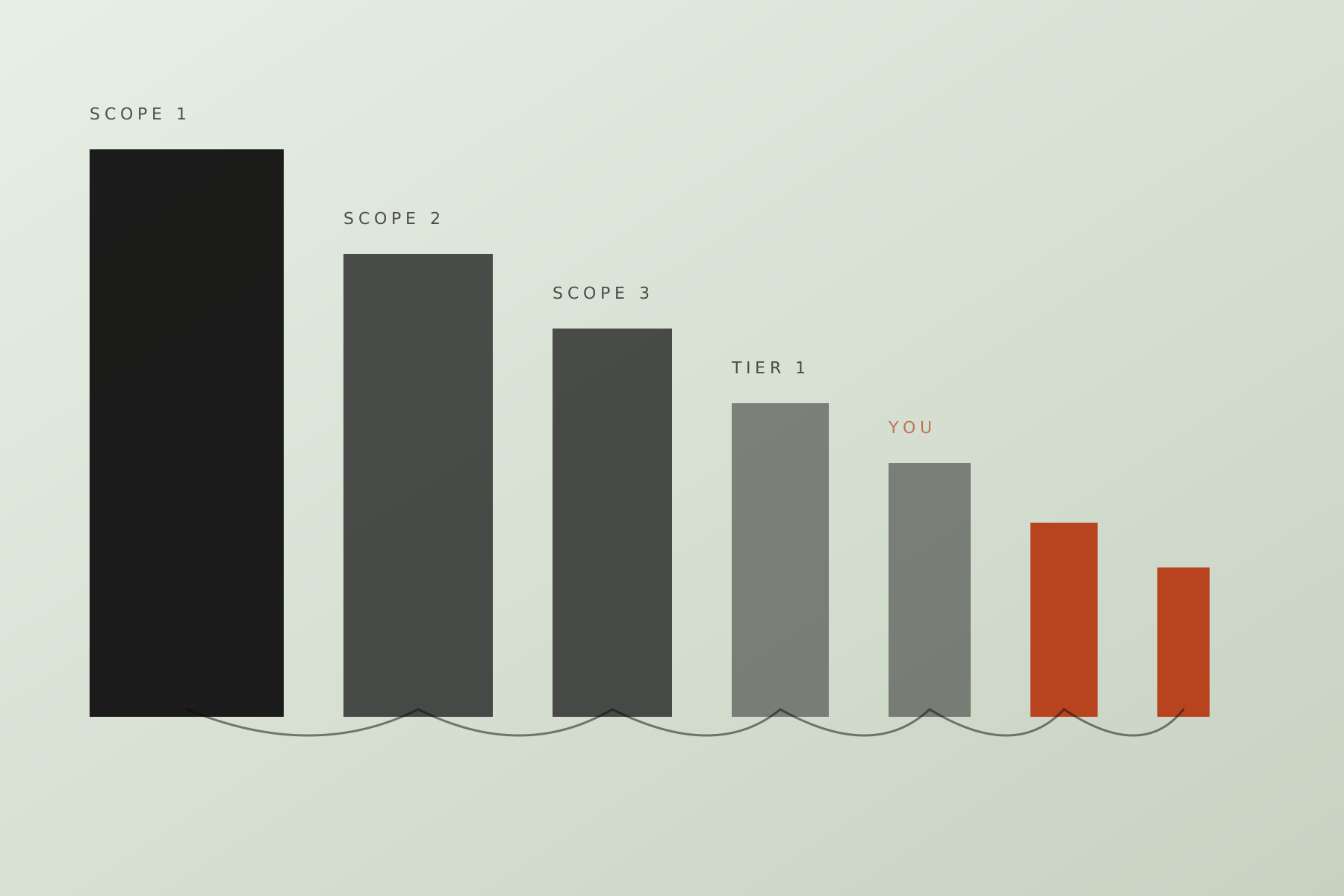
AASB S2 requires reporting of scope 1, scope 2 and (from the second year of compliance) scope 3 emissions. Scope 1 is direct combustion on the reporting entity’s premises. Scope 2 is the emissions associated with the electricity the reporting entity buys. Scope 3 is, in the standard’s definition, the emissions associated with the entity’s upstream and downstream value chain.
For a supermarket chain, scope 3 includes the carbon associated with every product on the shelf. For a bank, it includes the emissions of every portfolio company it lends to. For a mining major, it includes the emissions associated with the production of the equipment it buys.
In each of those cases the reporting entity does not directly control the emissions it must report. It can only estimate them. The estimation process is what the reporting entity’s procurement team is now asking small suppliers to help with.
What SMB suppliers are being asked for
Through 2025, Coles, Woolworths, BHP and the Big Four banks published supplier sustainability expectations. The language differs but the ask is consistent. A small or mid-sized supplier selling into these procurement functions is being asked for:
- A baseline of annual scope 1 and 2 emissions, in tonnes CO2-equivalent.
- A statement of the emission factors used and the boundary of the estimate.
- A commitment to a reduction trajectory, usually aligned with the customer’s own net-zero target.
- Evidence of the accounting methodology (most commonly the GHG Protocol for SMEs).
- Annual reporting against progress.
None of those four items is itself onerous. All of them together represent a meaningful one-off setup cost for a supplier with no sustainability function, and an ongoing reporting cost thereafter.
The CPA Australia 2025 small-business climate survey found that fewer than 20 per cent of Australian SMEs had measured their emissions. More than 40 per cent had been asked for sustainability data by a customer or lender. That gap is the compliance burden in a sentence.
The templated-form problem
The Business Council of Australia and the Australian Sustainable Finance Institute both called through 2025 for standardised SME data templates, to avoid each large buyer asking each small supplier the same questions in a slightly different form. That request is reasonable. As at April 2026 it has not been delivered at sector scale.
The Productivity Commission’s 2025 review of sustainability reporting burden flagged the cascading cost risk explicitly. The Commission’s view, put plainly, was that the current design requires large reporting entities to collect upstream data in a way the upstream suppliers are not equipped to provide. That mismatch is what a small supplier is dealing with in 2026.
More than 40 per cent of Australian SMEs have been asked for sustainability data by a customer or lender. Less than half that number have the data to provide.
The Climate Active route
The federal Climate Active programme, run by the Clean Energy Regulator, provides a certification pathway that turns the SME’s emissions baseline and offset position into a verified public claim. Enrolment rose through 2025 as more SMBs were pushed by procurement into establishing the underlying numbers regardless.
Climate Active is not the only route. The GHG Protocol for SMEs, the Small Business Act pro-forma templates from CPA and CAANZ, and (at a price) the consulting-firm offerings from the big-four accounting firms all produce comparable outputs. For a small business without budget, the free CPA templates are the practical starting point.
The liability angle
ASIC Chair Joe Longo confirmed in 2025 a one-year modified-liability transition for forward-looking statements under the S2 regime. That means reporting entities are not fully liable for forward-looking disclosures during year one. The implication for an SMB supplier is that its data is being used in statements the reporting entity is already legally exposed on. Getting the data wrong has consequences that accrue two levels up from the small supplier.
That is not a hypothetical liability. It is a practical one. Reporting entities, having accepted that exposure, are becoming more careful about the data they accept. The era of one-line supplier sustainability statements is closing. The era of audited, methodology-referenced, period-on-period data is opening.
What the best small suppliers are doing
Three moves are visible among the AU small suppliers that have made the transition without distress.
First, they have run a single one-off emissions estimate using the GHG Protocol for SMEs, signed off by their accountant. The estimate does not have to be perfect. It has to exist.
Second, they have documented their energy supply, transport, and waste arrangements in a single internal spreadsheet that is updated quarterly. This is not a carbon management system. It is a list of things the business buys and a factor next to each.
Third, they have designated one person, usually the owner, as the person who handles the customer sustainability request. Not the accountant, not the ops manager, the owner. The request requires context that only the owner has.
The small suppliers who have not done those three things will spend 2026 reacting to individual requests from individual customers. The ones who have will spend 2026 answering questions with numbers.
The second group will win more contracts. That is the compliance-by-procurement reality the supply chain has already arrived at, whether or not the legislation has.