The instant asset write-off is back where it always is in April: a temporary setting, a hard sunset, a chorus of industry bodies lobbying for permanence, and a small-business operator trying to decide whether to sign a quote for a $17,000 oven.
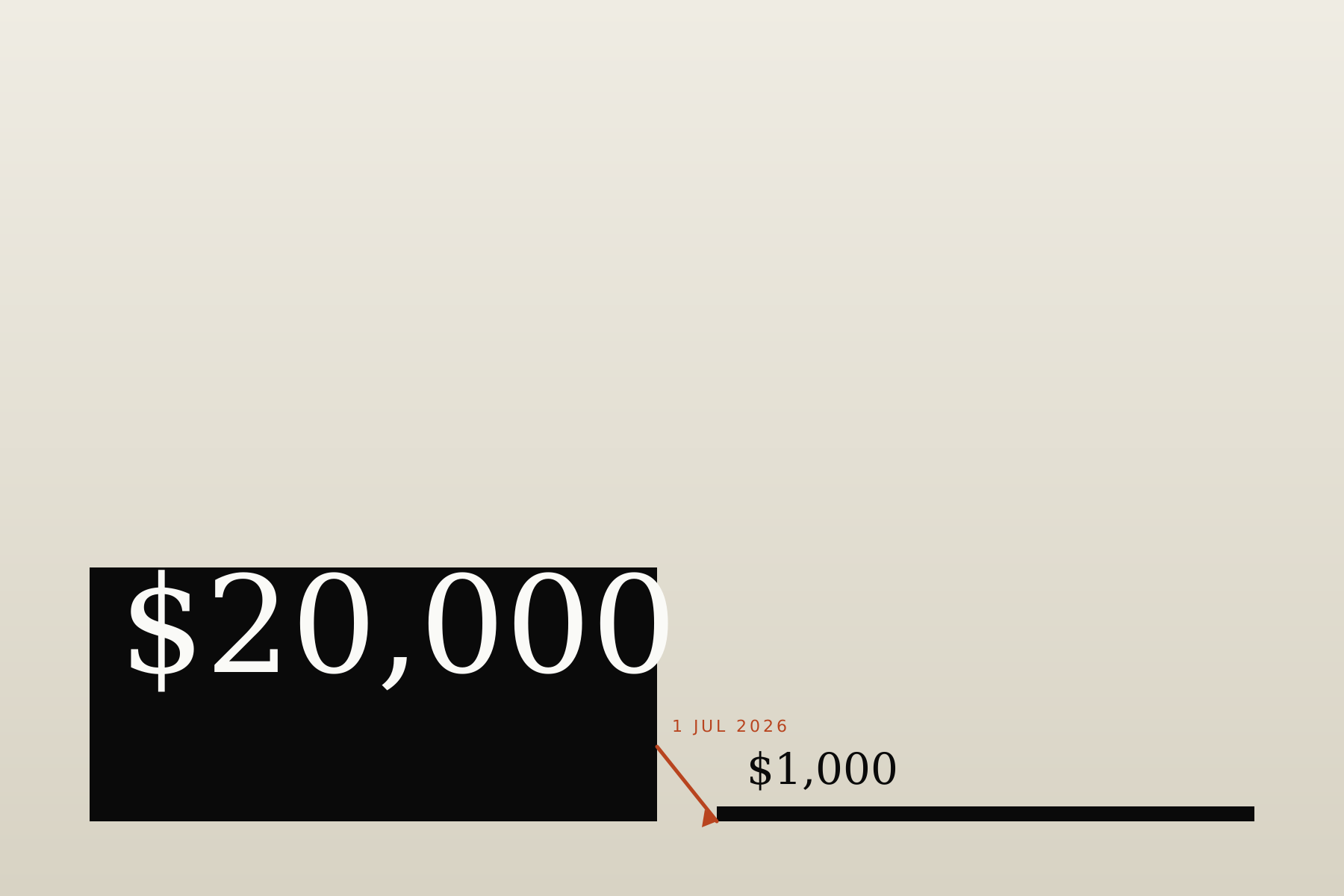
At the moment the threshold is $20,000, applied per asset, available to businesses with aggregated turnover under $10 million. Assets have to be installed ready for use between 1 July 2025 and 30 June 2026. On 1 July 2026, without new legislation, the threshold reverts to $1,000.
Why the reset matters more than the number
The headline figure (the jump from $1,000 to $20,000, or back again) distracts from the more interesting problem: the annual uncertainty itself.
The Council of Small Business Organisations Australia and the Commercial & Asset Finance Brokers Association have both called this year for a permanent threshold of $150,000, on the argument that small businesses cannot plan capital expenditure around a provision that rolls forward twelve months at a time. Moore Australia, in its April brief to clients, described the current arrangement as “a tax incentive pretending to be a planning tool.”
That is not a technical quibble. A fabricator looking at a $120,000 CNC with a twelve-week lead time needs to know whether the order placed in May will be installed in time for the relevant financial year. A cafe chain considering a four-site POS refresh has to answer the same question for every piece of equipment, individually, because the write-off is per asset rather than aggregate.
The per-asset design is the actual lever
Per-asset eligibility is the under-appreciated detail. A single owner-operator can, within a year, stack:
- a $17,000 commercial oven
- a $14,000 delivery van (second-hand, eligible)
- a $9,000 till and POS rollout
- a $3,000 espresso grinder
Each is written off in full in the year of installation. None crosses the $20,000 ceiling. The aggregate capex deducted in that year is $43,000, with no depreciation tail.
The $1,000 threshold that returns on 1 July makes all four of those purchases depreciable under the small-business pool rules: deductible, but over years, not now. In a year where cash flow is the binding constraint, the difference between “deductible this year” and “deductible over seven” is a material one.
Who actually uses it
Treasury’s own analysis puts current take-up below 40% of eligible businesses. The reasons are mostly the obvious ones. Businesses that are not already profitable have no taxable income to offset. Businesses in sectors with short asset lives (hospitality, retail) stack the write-off more readily than businesses with long-lived capital (trades, manufacturing). Businesses without an accountant on retainer often miss the install-ready deadline.
The write-off is, in other words, a subsidy that favours established, already-profitable, well-advised small businesses. That is not, on its own, an argument against it. But it is an argument against treating annual renewal as a substantive response to small-business productivity concerns.
What Canberra is likely to do
The short version: the write-off will probably be extended, at some threshold, in the May budget or immediately after. That has been the pattern in every budget since 2020, and the political cost of letting it lapse ahead of EOFY is not one either party has shown appetite for.
The longer version is less comforting. Treasury has been resistant to a permanent $150,000 on budget-integrity grounds (the provision was never designed to be a structural feature of the tax code). Industry wants permanence because it makes planning possible. Neither side has moved in three years.
The most likely outcome is another twelve-month extension at $20,000, with the door left open to review. Which is roughly what operators received last April.
What to do before 30 June
For businesses that are currently profitable, have asset purchases in mind, and can reasonably expect installation before 30 June, the advice is unchanged: bring them forward. For businesses that cannot, the advice is more useful than it sounds: do not panic-buy. A deferred purchase that lands in July will still be depreciable under the small-business pool, and a bad capex decision made to hit an artificial deadline will cost more than the deduction saves.
The cleaner question, the one the industry lobby is right to keep asking, is why small business is the only part of the economy expected to plan around policy that resets every twelve months.