The Skills in Demand visa went live on 7 December 2024, replacing the old subclass 482. It is a cleaner piece of legislation than what it replaced, with three streams (Specialist, Core, and Essential), tighter employer-sponsorship requirements, and a new Core Skills Occupation List that locked in 456 occupations, most of them relevant to the construction trades. Bricklayers, carpenters, roofers, electricians, plasterers, plumbers, and ceramic tilers are all on the list.
The federal redesign gets most of the policy attention. It deserves less of it than it receives, because the federal framework is not where the action has been. The action is underneath it, in the state-nomination programmes.
The builders’ problem, in numbers
The Housing Industry Association’s Trades Availability Index for Q4 2025 registered a national composite score of -0.47, with the following sub-readings by trade:
- Bricklaying: -1.02
- Ceramic tiling: -0.88
- Roofing: -0.75
- Carpentry: -0.62
- Plastering: -0.54
Negative readings on the HIA scale indicate shortages. -1.02 on bricklaying is the worst reading in the twenty-year history of the index.
Master Builders Australia’s 2024 Workforce Blueprint, now updated for 2026, puts the additional workforce required across building trades to meet the 1.2 million new homes target by 2029 at 130,000 people. That is against an existing workforce, for comparison, of roughly 1.3 million. The industry needs to grow its headcount by roughly 10% in four years, in an environment where unemployment has sat below 4.5% for most of that period.
There is no serious pathway to those numbers that does not include migration. The industry’s own numbers accept this: over 8,600 457/482 visa holders were sponsored by construction businesses at the end of 2025, which is more than double the level of a few years earlier and exceeds the peak the last mining boom recorded.
Where the three large states have landed
The federal visa gets a builder over the starting line. The state-nomination programme decides how long it takes to cross the room.
New South Wales has the largest nomination allocation for 2025-26 at 2,100 places under subclass 190 (permanent) and 1,500 under 491 (skilled work regional provisional). NSW’s process is paperwork-heavy, requires evidence of local employment offers, and runs on a conventional points-ranked invitation cycle. Construction occupations sit in the general queue.
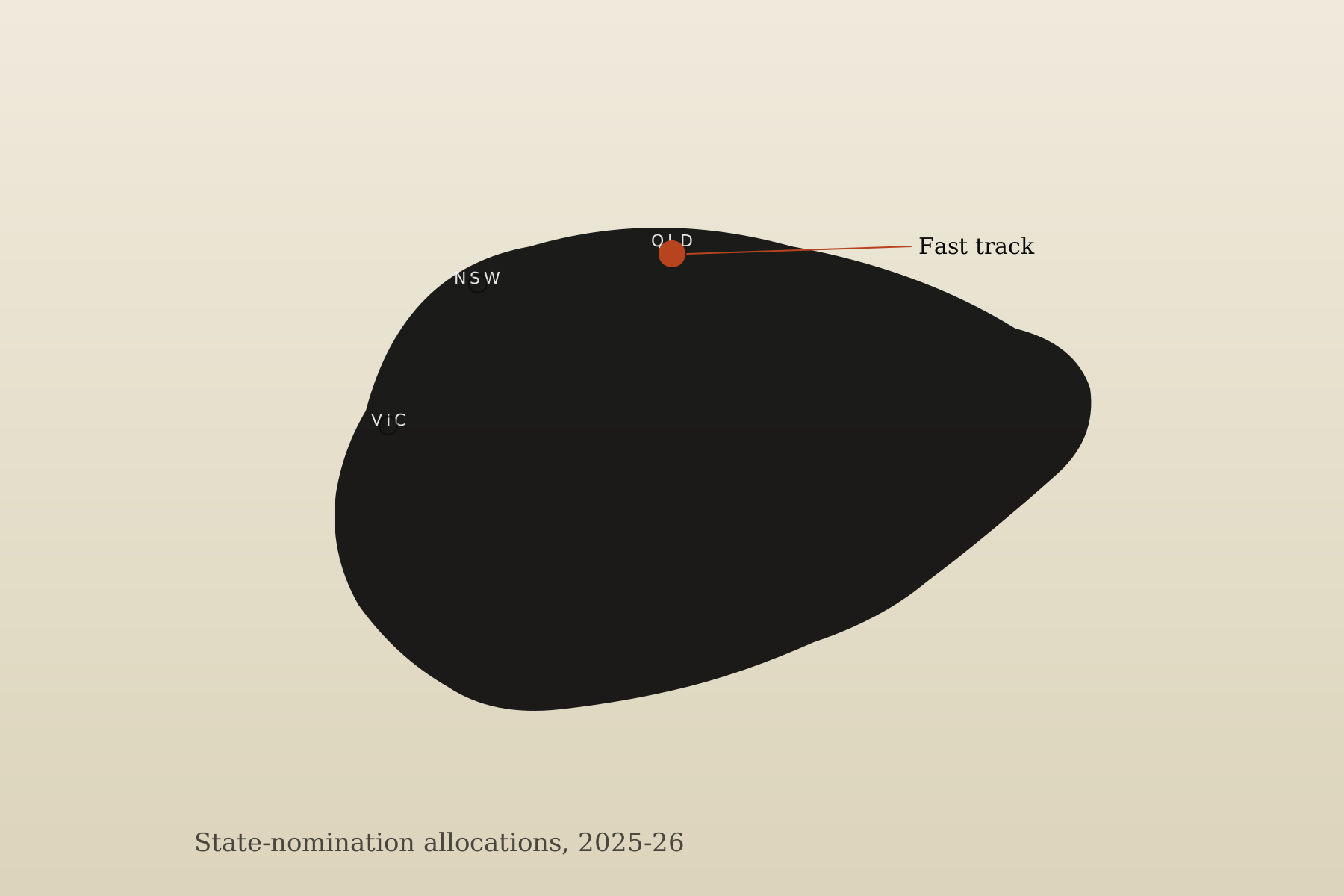
Queensland received a smaller allocation (1,850 under 190, 750 under 491) but has deployed the nomination programme differently. Queensland operates a specific three-month construction-trades pathway with no settlement-fund requirement, no state-specific English-language premium, and a nomination fee that is the lowest of the three largest states. The state’s Olympics-related infrastructure pipeline (roughly $60 billion in committed project spend through 2032) has been the stated justification for the fast-track design.
Victoria has the largest total allocation (3,400 places) and no nomination fee, but routes roughly 80% of invitations to onshore applicants already in Australia on a related visa. For a building-trade employer looking to sponsor a bricklayer from abroad, Victoria is, in practice, a slower pathway than the numeric allocation suggests.
The effect in the spreadsheet of a medium-sized construction SMB weighing where to place its next trades sponsorship, is straightforward. Queensland’s decision window is measurable in weeks. NSW’s is measurable in months. Victoria’s is measurable in months, with a further filter that many offshore candidates cannot pass.
The pricing of the trade
The federal income thresholds for the Skills in Demand visa rise on 1 July 2026: the Core Skills stream to $79,499, the Specialist Skills stream to $146,717, both indexed to Average Weekly Ordinary Time Earnings at 3.8%. For a construction employer sponsoring a carpenter or a bricklayer, the Core Skills threshold is the binding number, and $79,499 is comfortably above the award rate for most trades at the level of competence a sponsor would import.
The threshold is not a significant barrier at the Core stream. What matters more, operationally, is the difference between a three-month state process and a six-month one. On a project with a 24-month build window and a margin in the mid-single digits, three months of the labour allocation not being on site is, roughly, the project’s entire profit.
That is the arbitrage Queensland has built.
What NSW and Victoria will probably do
The quiet conversation among state-nomination policy staff (I spoke to three officials who asked not to be named) is that the Queensland fast-track is going to force a response. NSW is, per officials familiar with the process, reviewing its 190 allocation design with an eye to a similar construction-specific pathway, likely targeted for the 2026-27 allocation. Victoria’s options are narrower because its allocation is already overweight total, and the binding constraint is onshore/offshore routing rather than headline numbers.
The reasonable expectation is that by the middle of 2026, the three states will look less differentiated than they do right now. The operators who do not have that much time will be making their sponsorship decisions on the current settings, which means placing their sponsorship work in Queensland if they can legally structure it that way.
For a Sydney builder with a project in Campbelltown, that is, of course, not available. But for a nationally-active group, or for a trade-specific operator with capacity to relocate a nominated worker after initial settlement, the Queensland pathway is now the rational first move. Several of the national trade contractors I spoke to confirmed, off the record, that their sponsorship applications for 2025-26 were routed through Queensland entities, even where the underlying work was elsewhere.
That is not a migration-policy failure in itself. It is, however, a feature of the system that is not being measured, and that is doing more work than the federal redesign.