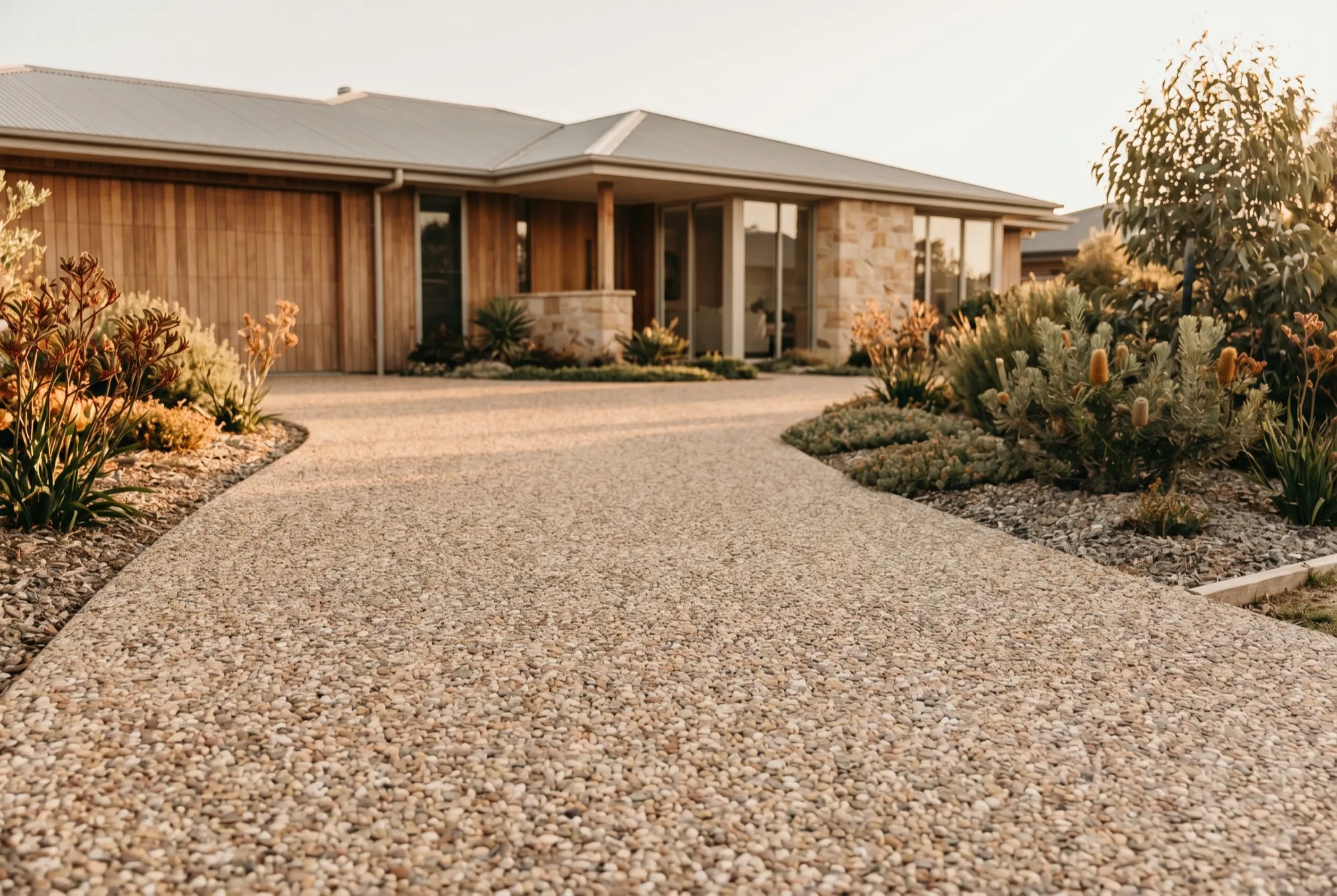
A concrete driveway in Australia commonly costs roughly $65 to $150 per square metre, depending mostly on the finish you choose. For a typical suburban driveway that usually works out to somewhere around $3,000 to $10,000 all up, and the only number that truly matters is the one a concreter writes on your actual quote.
That range is wide for a reason, and anyone who quotes you a sharp single figure over the phone without seeing the site is guessing. The price moves with the size of the slab, the finish, how much prep and excavation the ground needs, whether you want steel reinforcement and drainage, the slope of the block, and how easily a concrete truck and pump can get to the pour. Below we break down the per square metre ranges, the total picture, and the things that quietly push the bill up. (Prices last checked June 2026 and are indicative only.)
Concrete driveway cost per square metre
The headline figure most people search for is the per square metre rate, so let us start there. As a rough guide for June 2026, plain or standard concrete sits at the cheaper end, coloured and stencilled finishes land in the middle, and exposed aggregate or decorative work is the priciest. The table below gives the ranges we are seeing, but treat them as a starting point for conversation rather than gospel.
| Finish | Indicative cost (per m2) | What you get |
|---|---|---|
| Plain / standard concrete | $65 to $90 | A solid, grey, no frills slab |
| Coloured or stencilled | $90 to $120 | Through coloured concrete or a patterned, stencilled surface |
| Exposed aggregate / decorative | $100 to $150+ | Polished pebble look or designer finishes |
A few things to hold in mind when you read those numbers. Rates per square metre tend to drop a little on bigger jobs, because the fixed costs of getting the crew, the truck, and the pump on site get spread across more area. A tiny driveway can therefore cost more per square metre than a generous one, which surprises people. And the plus sign next to that top figure is doing real work, because high end decorative finishes and tricky sites can push well past $150.
What a whole driveway actually costs
Per square metre rates are useful for comparing finishes, but they are not what lands in your inbox. A concreter quotes the whole job, and that figure folds in everything from the base material to the labour to the cleanup. For a standard single or double driveway, most homeowners are looking at something around $3,000 to $10,000, and larger or fancier projects climb from there.
To turn a rate into a ballpark, measure your driveway in metres and multiply length by width to get the area, then multiply that by a rate from the table. A driveway that is roughly 4 metres wide and 12 metres long is about 48 square metres. At plain concrete rates that points to something in the order of $3,000 to $4,300, and a decorative finish on the same footprint could comfortably double it. Useful for a gut check, but it is not a quote, and it deliberately ignores the site specific costs that follow.
The rate per square metre tells you about the finish. The quote tells you about your block.
The cost drivers that move the price
This is where two driveways of identical size end up thousands of dollars apart. None of these show up cleanly in a per square metre figure, which is exactly why a site visit matters.
Site preparation and excavation
Before any concrete is poured, the ground has to be made ready. That can mean excavating, levelling, compacting a base, and carting spoil away. A flat, stable, already cleared site is cheap to prep. Soft soil, tree roots, or a surface that needs building up costs more, and the bill grows quietly before a single bag of cement is opened.
Removing the old driveway
If there is an existing driveway in the way, someone has to break it out and dispose of it. Demolition, removal, and tip fees are a line item people routinely forget when they are budgeting from a per square metre rate, and on a thick old slab it is not trivial.
Reinforcement, drainage, and slope
Steel reinforcement (mesh or bar) adds strength and helps control cracking, and most driveways want it. Drainage matters where water needs somewhere to go, and a sloped or awkwardly graded block can need extra formwork, retaining, or engineering. If your project is creeping into retaining territory, our guide to retaining wall cost is worth a look before you commit.
Access for the truck and pump
Concrete is heavy and it sets on a clock, so getting it from the truck to the formwork is a genuine cost factor. An easy pour straight off the truck is cheapest. A backyard slab behind a narrow side gate may need a concrete pump or wheelbarrowing, and both add to the labour. The harder it is to reach, the more you pay.
Finish options, and why they cost what they do
The finish is the single biggest lever on the per square metre rate, so it is worth understanding what you are paying for.
Plain concrete is the workhorse: durable, practical, and the cheapest way to get a solid driveway. It is grey, and that is the whole pitch.
Coloured and stencilled finishes give you something with a bit more character. Colour can be mixed through the concrete or applied to the surface, and stencilling presses a pattern in before it cures, mimicking pavers or brick at a lower cost than the real thing.
Exposed aggregate and decorative finishes sit at the top. Exposed aggregate washes back the surface to reveal the stone within, giving that textured, premium pebble look. It is popular, it is hard wearing, and you pay for it. Other designer finishes such as polished or patterned concrete can push higher again.
Whichever you choose, the fundamentals do not change: concrete needs proper curing and well placed control joints to manage the cracking that all concrete eventually wants to do. Skimp on those and even an expensive finish can fail early, so it is not the place to chase a cheap quote.
How to get an accurate price
Because so much of the cost is site specific, the genuinely useful step is to get a few real quotes rather than relying on any online figure, including this one. Get at least two or three concreters out to look at your block, and make sure each quote spells out the finish, the reinforcement, the prep and excavation, drainage, removal of the old driveway if relevant, and the cleanup. When the quotes are itemised like that, you can compare them properly instead of staring at three different bottom line numbers.
The simplest way to line up a few comparable prices is to get concreting quotes from local tradies and let them assess the site in person. If you are weighing up a concreter against other options or just want a sense of who is reputable, our guide on how to find a good tradie covers what to ask and what to watch for.
It also helps to see the driveway as one piece of a bigger picture. If it is part of a larger project, our rundown of home renovation costs in Australia puts the spend in context, and if you are landscaping around the new slab, the landscaping cost guide is a sensible next read.
The bottom line
Budget roughly $65 to $150 per square metre for a concrete driveway in Australia, with plain concrete cheapest and exposed aggregate or decorative finishes dearest, and expect most full jobs to land somewhere around $3,000 to $10,000 (indicative, last checked June 2026). The finish sets the baseline rate, but site prep, excavation, reinforcement, drainage, slope, access for the truck and pump, and removing any old driveway are what actually decide your final figure.
So treat every number here as a guide and nothing firmer. Prices vary by finish, site prep, and access, and the only real number is the one on a written, itemised quote for your block. Get a few of those, compare them like for like, and you will know exactly what your driveway costs rather than what the internet reckons it might.