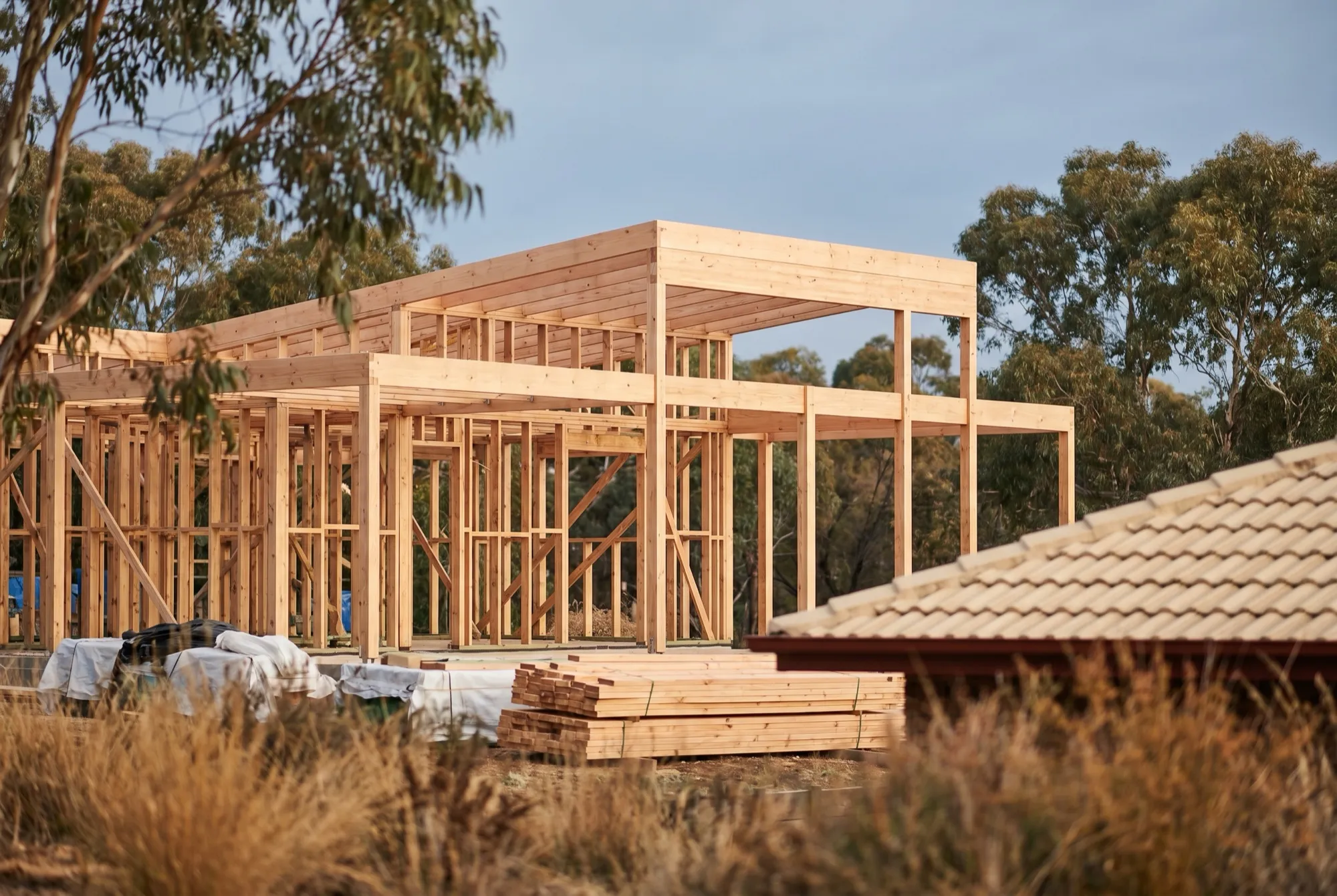
Building a new house in Australia generally costs somewhere between $1,800 and $5,000+ per square metre of floor area, which puts a standard four-bedroom project home around $300,000 to $500,000+ before you have even paid for the land. Where you land in that range depends almost entirely on who builds it, what you put inside it, and how cooperative your block of dirt decides to be.
That is the short answer. The longer answer, and the one that keeps people up at night, is that the headline number on a glossy brochure is rarely the number you actually hand over. So let us walk through it properly.
The quick version: cost per square metre
The construction industry loves to talk in dollars per square metre, and for good reason: it is the cleanest way to compare a 180 square metre home with a 320 square metre one. The catch is that “per square metre” only covers the build itself. It does not include the things that turn a flat slab on an easy block into a project on a steep, rocky one.
Here is roughly where the three main tiers sit, last checked June 2026. Treat these as ballpark figures, because every builder prices differently.
| Build type / tier | Rough cost per square metre | What you tend to get |
|---|---|---|
| Volume / project-home builder | $1,800 to $2,800 | Standard floor plans, fixed inclusions, the cheapest path |
| Mid-range build | $2,500 to $3,500 | More choice, better fittings, some custom changes |
| Custom / architectural | $3,500 to $5,000+ | Bespoke design, premium finishes, near-unlimited scope |
These ranges move with materials, labour, location, and the size of the home (smaller builds often cost more per square metre, because the kitchen and bathrooms, the expensive rooms, take up a bigger share of the floor area). They are a starting point for a conversation with a builder, not a quote.
What the total actually looks like
For most Australians, the realistic option is a project or volume builder. A standard four-bedroom, two-bathroom home from one of the big builders commonly lands somewhere around $300,000 to $500,000+ to build, again before land. Go single-storey on a small, simple block and you can sit near the bottom. Add a second storey, a bigger footprint, or nicer-than-base finishes, and you climb quickly.
Step up to a genuinely custom or architect-designed home and there is effectively no ceiling. Double-height voids, imported stone, full-height glazing, and a one-off design all cost what they cost. That is the trade for getting exactly the house you want rather than one off the menu.
Two homes with identical floor plans can finish hundreds of thousands of dollars apart, purely on inclusions and site.
The costs that sit outside the base price
This is the part the brochures are quiet about, and it is where budgets most often come unstuck. The advertised base price is for the house. It usually assumes a flat, stable, easy block with services at the boundary. Reality is messier, and the extras are not optional.
Site costs
Your block has a big say in the final bill. The usual suspects:
- Soil type. Reactive clay or soft ground needs a more engineered slab, which costs more.
- Slope. A sloping site can add a lot, through cut and fill, retaining walls, or a stepped or suspended design. Difficult sites are where budgets quietly balloon.
- Rock. Hit rock during excavation and costs go up fast.
- Retaining walls. Often needed on a slope, and rarely cheap.
Connections, fees, and the finishing touches
Beyond the dirt, a handful of line items appear on nearly every build:
- Service connections for water, sewer, power, gas, and the NBN, especially on a new or rural block.
- Council and certification fees, including approvals, permits, and inspections.
- Driveways, paths, fencing, and landscaping, which are frequently excluded from the base price and add up to real money.
- Demolition, if you are doing a knockdown-rebuild on an existing block.
If you are weighing a new build against staying put and reworking what you have, it is worth pricing both. Our guides on home renovation costs in Australia and the cost of a house extension can help you compare the two paths with eyes open.
Why the cheapest base price can be the most expensive
It is tempting to chase the lowest number on the brochure. Resist a little. The cheapest base price often comes with the thinnest inclusions, which means the upgrades you assumed were standard, like decent floor coverings, better appliances, taller ceilings, a few extra power points, are extras. By the time you have brought a bare-bones build up to the spec you actually pictured, the “cheap” builder can end up dearer than the one whose base price looked higher but included more.
So compare inclusions, not just headline prices. Read the specification line by line. And pay close attention to provisional sums and prime cost items, which are the builder’s estimates for things not yet finalised, like site costs or tiling. If those estimates are set low, the contract looks cheaper on paper and you pay the difference later.
The only number you can truly bank on is the one written into a fixed-price building contract.
Get it in writing: the fixed-price contract
If you take one thing from this article, take this: the only number that genuinely counts is the one in a fixed-price building contract. Everything before that, the per square metre figures, the brochure totals, the ranges in this article, is an estimate to help you plan, nothing more.
A proper fixed-price contract should spell out the inclusions, the finishes, the allowances, and how variations are handled if you change your mind partway through. Read it carefully, ask about anything vague, and be wary of a contract stuffed with low provisional sums, because those are the gaps where the price can creep up.
Before you sign anything, it pays to talk to more than one builder. You can compare quotes from licensed builders to get a feel for the real range in your area and for what different builders include at their base price. And if you are still assembling your team, our guide on how to find a good tradie covers what to check before you hand anyone a deposit.
A few things that shift the number
Costs are not fixed in stone, and a handful of choices move the needle more than the rest:
- Single versus double storey. A second storey usually costs more per square metre than spreading out, though it can be the cheaper option on a small or pricey block.
- Size. Bigger is dearer overall, but the per square metre rate often eases a little as the home grows, because the costly rooms are a smaller share of the whole.
- Finishes. Tiles, tapware, benchtops, and joinery span an enormous price range. This is where personal taste meets the budget head-on.
- Location. Labour and material costs, and council requirements, vary across states and between city and regional areas.
The bottom line
Building a house in Australia in 2026 typically runs $1,800 to $2,800 per square metre with a volume builder, $2,500 to $3,500 mid-range, and $3,500 to $5,000+ for custom or architectural, which puts a standard four-bedroom project home around $300,000 to $500,000+ before land (figures last checked June 2026, and they vary by builder, site, and inclusions). Whatever range you start from, remember that site costs, connections, fees, and landscaping sit outside that base price, the cheapest brochure price often hides the thinnest inclusions, and the only number you can truly rely on is the one written into a fixed-price contract. Get a few quotes, read the inclusions like your wallet depends on it, because it does, and you will avoid most of the nasty surprises.