Insurance used to be the line item small-business owners did not think about. A broker quoted once a year, the premium went up a bit, the policy renewed, and the owner went back to the real problem of the month.
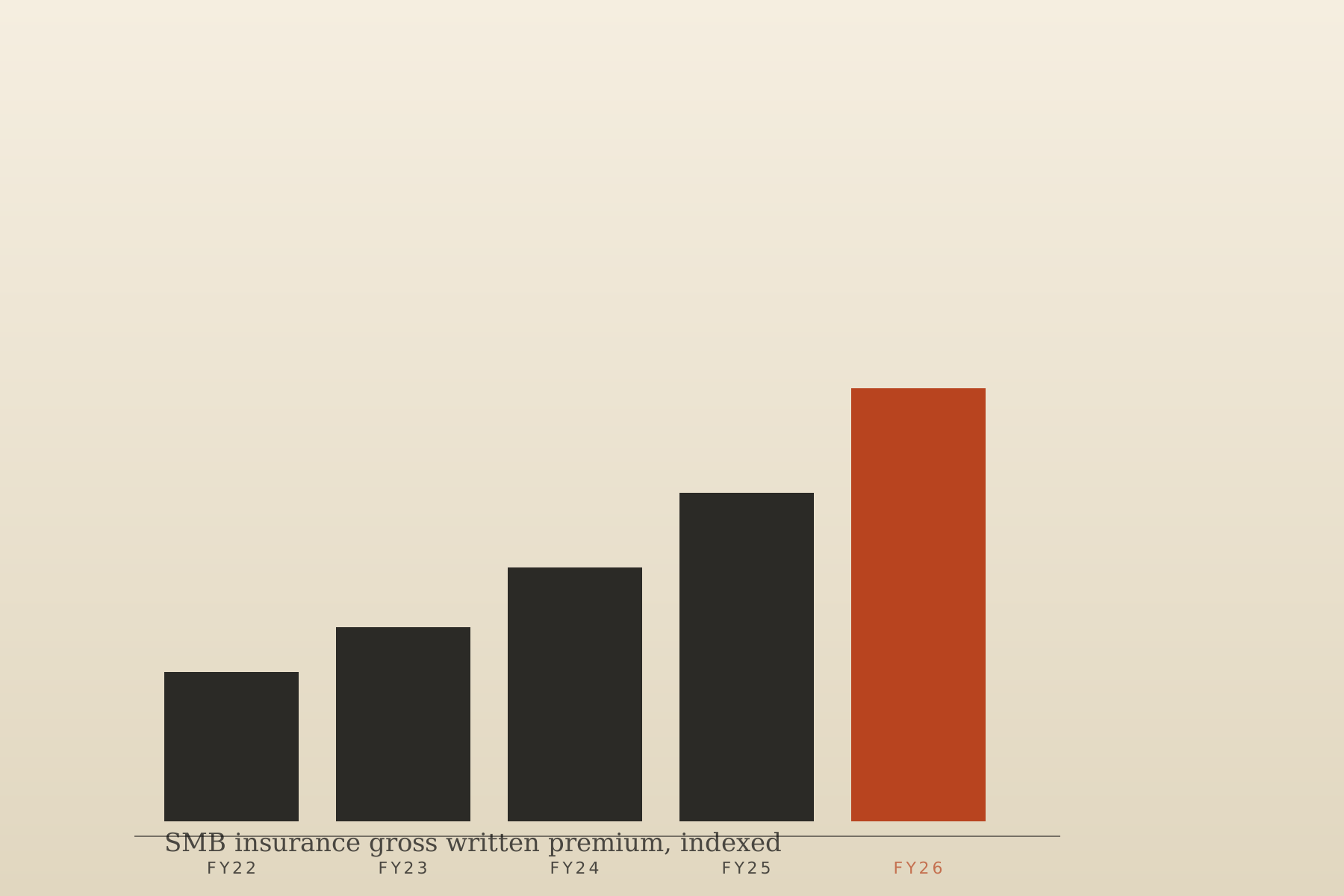
That dynamic broke some time in 2022, and it has not been repaired since. APRA’s quarterly general-insurance statistics to September 2025 showed gross written premium growth in commercial lines continuing above 10 per cent year on year, led by property and liability classes. The reinsurance layer that sits behind Australian insurers has repriced by roughly 30 per cent since 2022, per commentary from Insurance Council of Australia chief executive Andrew Hall through 2025. Those two numbers compound into the quote a small business sees at renewal.
For SMBs in certain categories, the renewal no longer looks like a price adjustment. It looks like an exit notice.
The categories the market will not write
Insurance brokers Honan, Marsh, Gallagher and Steadfast have all reported through 2025 and early 2026 that three small-business categories are now considered “distressed” placement classes:
- Childcare centres, especially those operating in or adjacent to combustible-cladding buildings, post the cladding-related claims wave.
- Hospitality venues with late-night trading hours and public liability exposure.
- Trades with height work, including roofers, solar installers and scaffolders.
“Distressed” is broker language. What it means operationally is that the placement takes longer, the panel of insurers willing to quote is smaller, and the eventual premium sits above what the business owner budgeted. For some of the smallest operators in these categories, the renewal simply cannot be placed at all.
That is the go-or-no-go point. An SMB that cannot obtain public liability cover cannot legally operate in most settings. The insurance market, in effect, is making sector-level eligibility decisions that no regulator has been asked to ratify.
The workers’ comp layer
State workers’ compensation schemes have moved in the same direction. icare NSW announced an average 8 per cent premium increase for 2024-25, with psychological injury claims cited as the fastest-growing cost category. WorkSafe Victoria signalled further rate reviews through 2025-26. In both states, the employer’s premium is largely a function of the scheme’s aggregate claims experience, which means individual employers with clean claims records are subsidising the schemes’ overall deterioration.
The psychological injury category is the one to watch. Claims in this category are rising faster than premium, which means the next revaluation cycle is likely to produce another lift.
The cyber stabilisation
The one category where the market has loosened slightly is cyber. Honan’s Q1 2026 market update reported cyber premiums stabilising after the 2022-24 spike. The condition of that stabilisation is that insurers are now requiring materially stronger underwriting warranties: multi-factor authentication across all privileged accounts, tested backup procedures, and in some cases endpoint detection and response software as a policy precondition.
For small businesses that can meet those warranties, cyber premiums in 2026 are roughly flat on 2024. For those that cannot, the market will either decline to quote or will return with a 15 to 25 per cent renewal increase and tighter sublimits on the categories where ransomware exposure is concentrated.
I am telling every SMB client to treat this renewal as though placement is not guaranteed. That is not how we have had to talk to clients in twenty years.
The ASIC layer
The insurance regulator was quiet for most of the past decade. It has become less quiet. ASIC’s late-2025 claims-handling review, which examined how general insurers manage consumer and SMB claims after lodgement, produced recommendations that have added compliance cost at the insurer level. Those costs, too, flow through to premium.
APRA, separately, has raised capital expectations on the mutual insurers that underwrite much of the smaller end of the AU commercial market. Those capital requirements are an additional pressure on pricing.
What SMB owners are doing
The operators weathering this environment are doing three things.
First, they are commissioning brokers to go to market earlier, in some cases 90 days before renewal rather than the traditional 30. That extra window gives the broker time to get offers from the full insurer panel rather than falling back to the incumbent.
Second, they are accepting higher excesses in exchange for smaller premium rises. For a small trades business with a clean claims record, moving the excess from $500 to $5,000 can reduce the premium by enough to pay for two or three years of a worst-case out-of-pocket claim.
Third, they are reviewing the actual coverage rather than renewing on autopilot. In several cases I have seen, businesses were paying for sublimits they did not need, or carrying duplicate coverage on two related policies.
That is not a fix for the structural pressure. But it is what the best-run SMB operators are doing this year, and they are doing it because the alternative, a 20 per cent compound renewal increase into year three, is not survivable at most operators’ margin.
The broker panel will not say this on the record, but the quiet expectation for 2027 is another 8 to 12 per cent on commercial property and liability. For small business, insurance has stopped being a line item.