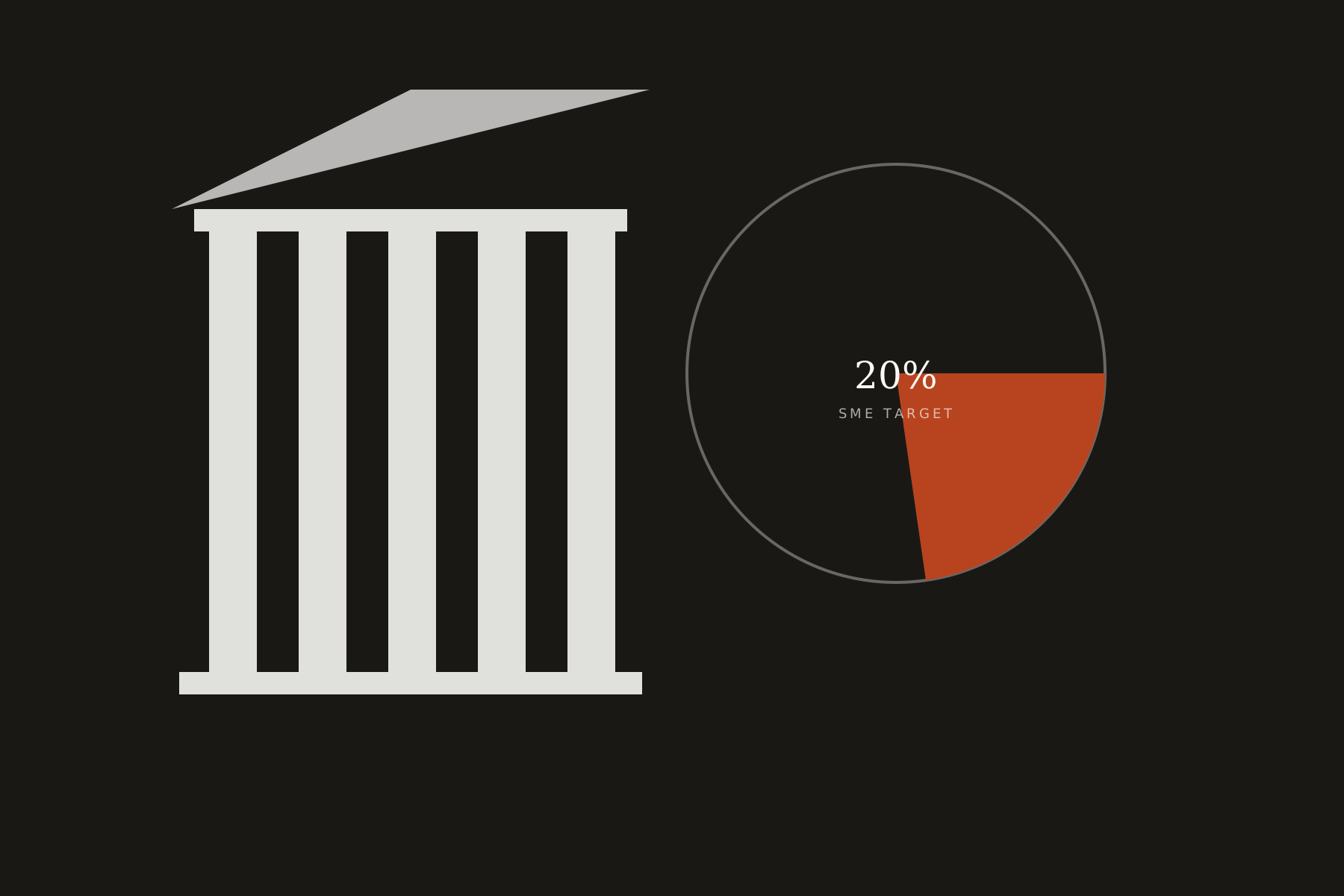
The Commonwealth Procurement Rules commit the federal government to sourcing at least 20 per cent of procurement contracts by value from SMEs, and 35 per cent by volume for contracts under $20 million. The number is genuine, and the Department of Finance publishes against it annually.
But the number is not a description of how small firms actually win Commonwealth work. The mechanics are a stack of panels, standing offers, sub-threshold direct engagements, and informal relationships that sit below the public-tender surface. A small business that understands the stack wins work that a small business that does not cannot.
The three channels
Broadly, Commonwealth spend with SMEs flows through three channels.
One: open tenders published on AusTender. These are the loudest channel because they are the most visible. They are also the smallest slice of the total. For any SME without an existing relationship with the buying agency, an open AusTender bid is, in most cases, a bid against incumbents with better information. Win rates for cold bidders are low.
Two: panel arrangements. Whole-of-government and agency-specific panels (for ICT, management consulting, legal, audit, research, creative and communications) aggregate a pre-qualified supplier list that agencies draw from without running full tenders. The Digital Marketplace (BuyICT) and the Management Advisory Services panel are the two best-known. Panel membership is itself a one-off investment; the bid response for panel admission is substantial. Once in, the practical benefit is large: agencies can engage panel members for sub-threshold work directly, usually through a statement-of-work rather than a new tender.
Three: sub-threshold direct engagement. For contracts under $80,000 for most agencies, or higher thresholds in specific categories, a single agency officer can engage a supplier directly. This is where much of the actual SME spend happens, and where existing relationships dominate.
Where the rules actually are
The Commonwealth Procurement Rules (current edition, Department of Finance) set the 20 per cent SME value target and the 35 per cent volume target. The Buy Australian Plan, introduced in the 2023-24 federal budget and extended in subsequent updates, has added further preference rules favouring Australian-made goods and Australian-owned suppliers.
State procurement operates under parallel regimes. The NSW SME and Regional Procurement Policy, the Victorian Government Social Procurement Framework, and the Queensland Procurement Policy each provide state-specific settings. Queensland’s framework is the most favourable to very small suppliers through its Office of Small Business arrangements; Victoria’s social procurement framework creates a specific Aboriginal-business preference pathway.
The ASBFEO has continued to push through 2025 for the 30-day payment standard to be enforced for Commonwealth suppliers on contracts up to $1 million. That standard is still uneven in implementation across agencies.
The win rate on the first open tender is two per cent. The win rate on the first panel SoW after joining a panel is thirty.
The four moves that work
Small businesses that win Commonwealth work repeatedly do four things the ones that do not, do not.
- They invest in panel admission. Even for a single-director consultancy, a Management Advisory Services panel bid or Digital Marketplace registration is a one-off exercise that opens the sub-threshold engagement door for the following three years.
- They build relationships pre-procurement. Agency industry briefings, vendor-briefing sessions on upcoming market approaches, and technology demonstrations are the channels where future procurements are scoped. Small suppliers who attend those briefings are substantially better positioned when the procurement opens.
- They use the categorisation advantage. Each year’s Commonwealth procurement spend is broken out by UNSPSC category. A small supplier can read the previous year’s AusTender data for categories relevant to their offering and identify the agencies buying. That is free market intelligence. Most do not use it.
- They price to the buyer’s budget, not to the job. Agency buyers are working against annual budget allocations. A quote that exceeds the allocation will not be awarded regardless of its quality. The quote that sits inside the allocation, even if it describes a narrower scope, is the quote that gets the engagement. The scope can expand later.
The two honest realities
First, the 20 per cent target is a value target. SMEs win a higher share of contract volume (35 per cent) than value. A small supplier should not expect to win the largest contract in their category; they should expect to win many of the smaller ones.
Second, government work pays slowly relative to private-sector work. The 30-day standard is an aspiration; 45 to 60 days is typical for many agencies, with the ATO and Services Australia among the better-performing payers and some portfolio agencies among the worse. A small supplier taking government work for the first time should model cash flow assuming the worst payment profile they have quoted against commercially.
The commercial case for selling to government, for an Australian SME in 2026, is better than it has been for most of the past decade. The target is genuine, the preference rules favour Australian suppliers, and the sub-threshold layer is where the actual volume lives. Getting into that layer requires one-off investment in panel admission and a posture that treats the agency buyer as a client with a budget, not an enemy with a tender process.
The SMEs that make those adjustments win. The ones that do not, lose to the incumbents, and draw the conclusion that government is impossible to sell to. Both conclusions are available from the same data.