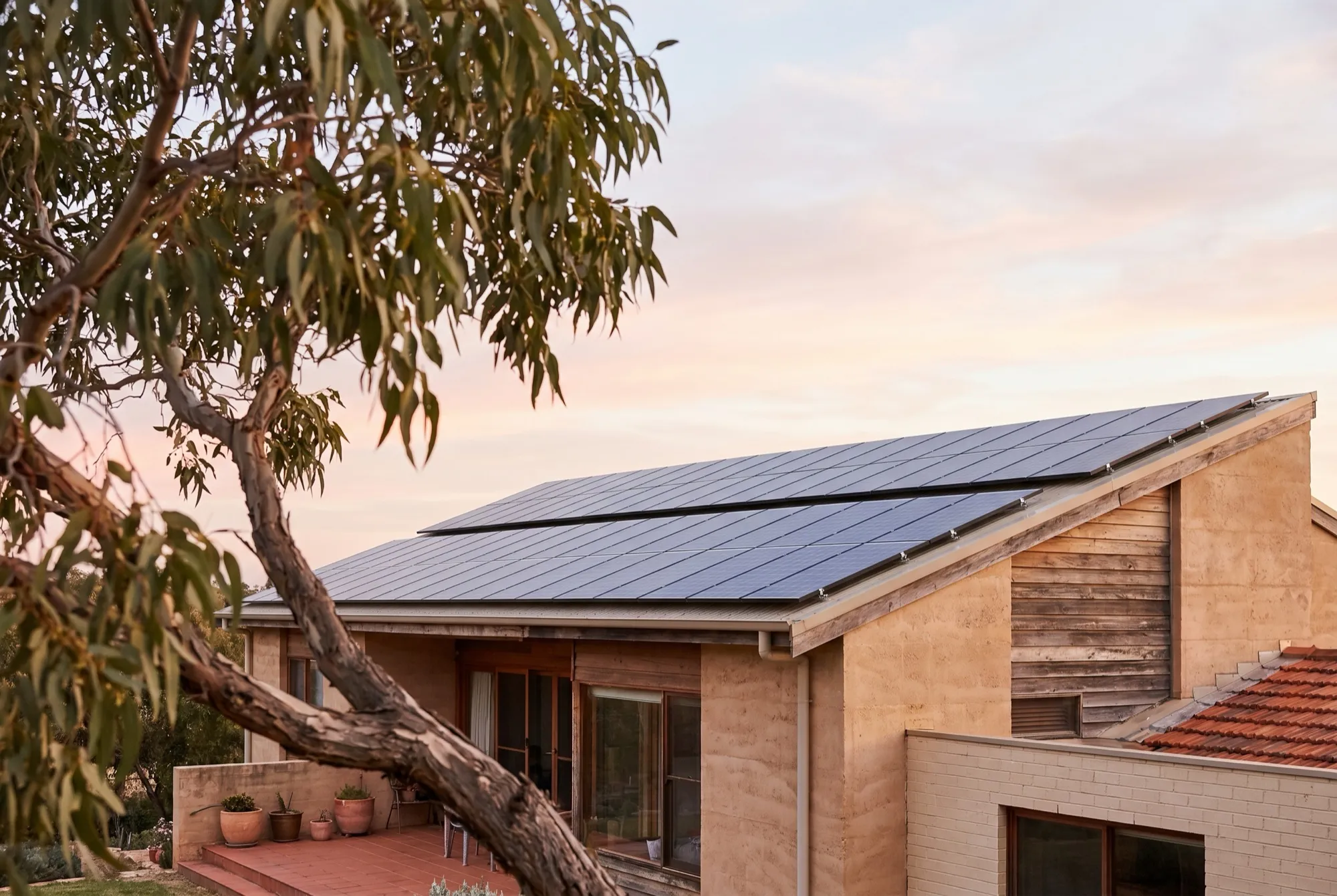
Most Australian homes need somewhere between 15 and 30 solar panels, which in 2026 works out to roughly a 6.6kW to 13kW system. As a quick rule of thumb, divide your average daily power use in kilowatt-hours by about 4, and that is the system size in kilowatts you want, so a home chewing through 26 kWh a day points to roughly a 6.6kW system, or about 15 panels.
That is the short answer. The longer answer is that the right number depends less on the size of your roof and more on how and when you actually use electricity, plus whether a battery is in your future.
Start with your usage, not your roof
The single most useful number you have is your daily power consumption. Pull out a recent electricity bill and look for the average daily usage in kilowatt-hours (kWh). Most retailers print it right there, often with a tidy bar chart comparing you to your neighbours.
A typical Australian household uses somewhere in the range of 16 to 30 kWh a day, though that varies a lot with climate, household size, pool pumps and how many teenagers are running hot showers. Once you have that number, the sizing maths is refreshingly simple.
The rule of thumb again, in plain terms: 1kW of solar produces very roughly 4 kWh a day averaged over a year in much of Australia. So to cover your usage on paper, divide daily kWh by 4 to get the kilowatts of panels you need.
The catch is that this is an annual average. Output swings with the seasons, and it only helps your bill when your panels generate at the same time you are using power. More on that shortly.
What a panel actually is in 2026
When people ask “how many panels”, the honest answer is that panels keep getting more powerful, so the count keeps shrinking for the same system size. A standard residential panel in 2026 is around 440 to 460 watts, up from the 250W to 330W panels common a decade ago.
So the maths is straightforward. A 6.6kW system needs roughly 15 panels, a 10kW system around 22, and a 13kW system about 28 to 30. The table below is the back-of-the-envelope version.
| Daily usage (kWh) | Rough system size | Panels (at ~450W) | Best suited to |
|---|---|---|---|
| 10 to 16 | 5kW to 6.6kW | 11 to 15 | Smaller homes, units, low daytime use |
| 16 to 25 | 6.6kW to 8kW | 15 to 18 | Average family home |
| 25 to 35 | 8kW to 10kW | 18 to 22 | Larger homes, some daytime load |
| 35+ | 10kW to 13kW | 22 to 30 | Big households, pool, future battery or EV |
Figures above are indicative ranges, last checked June 2026, and round panel counts up to whole numbers. Your installer will tweak the exact layout to suit your roof, shading and inverter.
Why most installers now fit the biggest system that fits
A decade ago the advice was to size solar conservatively to match your bill. That advice has aged. Panels have become so cheap that the hardware is often a minor part of the job, while labour, scaffolding, paperwork and the inverter are fixed costs whether you fit 15 panels or 25.
The upshot is that many installers now quietly recommend filling the roof with the largest system the roof area and inverter will allow. The marginal cost of a few extra panels is small, and that extra capacity future-proofs you for an electric vehicle, a battery, or simply a hotter summer.
Panels are now the cheap part of a solar system, so the question has quietly shifted from how few you can get away with to how many your roof and inverter will allow.
There are limits, though, and they are not about your roof. Two things cap how big you can go.
Inverter size
The inverter is the box that turns DC from your panels into AC for your home, and it is usually the real ceiling on system size. A common setup pairs an array with an inverter rated a little smaller, since panels rarely all hit peak output at once. Push much beyond that ratio and you start wasting generation. If you want a big array, you need a big enough inverter to match.
Network export limits
Your local network operator caps how much power you can export back to the grid, and in many areas that cap has tightened as suburbs fill up with solar. Some networks limit exports to around 5kW per phase, others less, and a few apply dynamic limits that throttle you when the grid is congested. A 13kW array on a single-phase home with a 5kW cap will spill a lot of midday generation it cannot sell.
This is exactly why usage matters more than roof space. If you hit your export cap at midday, the value of extra panels comes from powering your own home and charging a battery, not from feed-in credits. It is worth checking what your feed-in tariff actually pays before you bank on selling surplus, because in 2026 those rates are thin.
How a battery changes the answer
If a battery is on your shortlist, size up. A battery soaks up the solar you generate during the day and hands it back at night, which means a larger array suddenly earns its keep instead of spilling over the export cap.
The practical move is to fit enough panels to cover your daytime usage and fully charge the battery on an average day, with a buffer for cloudy stretches and winter. That usually pushes households into the 10kW-plus bracket, around 22 to 30 panels. Our guide to solar battery costs walks through whether the payback stacks up in 2026.
Even without a battery, think about your daily rhythm. A household that is empty from 9 to 5 uses very little of its own midday solar, so the case for a giant array rests almost entirely on export credits and any future battery. A household with someone home, a pool pump, or a work-from-home setup uses far more solar directly, and a bigger system pays off faster.
What it costs to put on the roof
Sizing and cost are two sides of the same decision. A 6.6kW system, the most popular residential size, typically runs around $5,000 to $9,000 installed after the federal STC rebate, last checked June 2026. Larger systems cost more in absolute terms but usually less per kilowatt, which is part of why going bigger is tempting.
Prices vary widely with panel and inverter brand, roof complexity, your state and how many quotes you get. For a full breakdown, see our guide to solar panel costs in Australia, and if you are still on the fence, is solar worth it lays out the payback case.
The most accurate way to settle on a number is to size a system to your postcode and usage, since sun hours, export rules and prices all shift depending on where you live.
The bottom line
Forget about counting panels first. Start with your average daily kWh from a recent bill, divide by about 4 to get a rough system size in kilowatts, then translate that into panels at roughly 450W each. Most Australian homes land between 15 and 30 panels.
From there, lean towards the larger end if you have the roof, a big enough inverter and any plan for a battery or EV, because panels are cheap and the extra capacity future-proofs you. Just check your network’s export limit and feed-in rate before you assume surplus solar will pay its way. Get a few quotes, match the inverter to the array, and size for the home you will have in five years, not just the bill you have today.