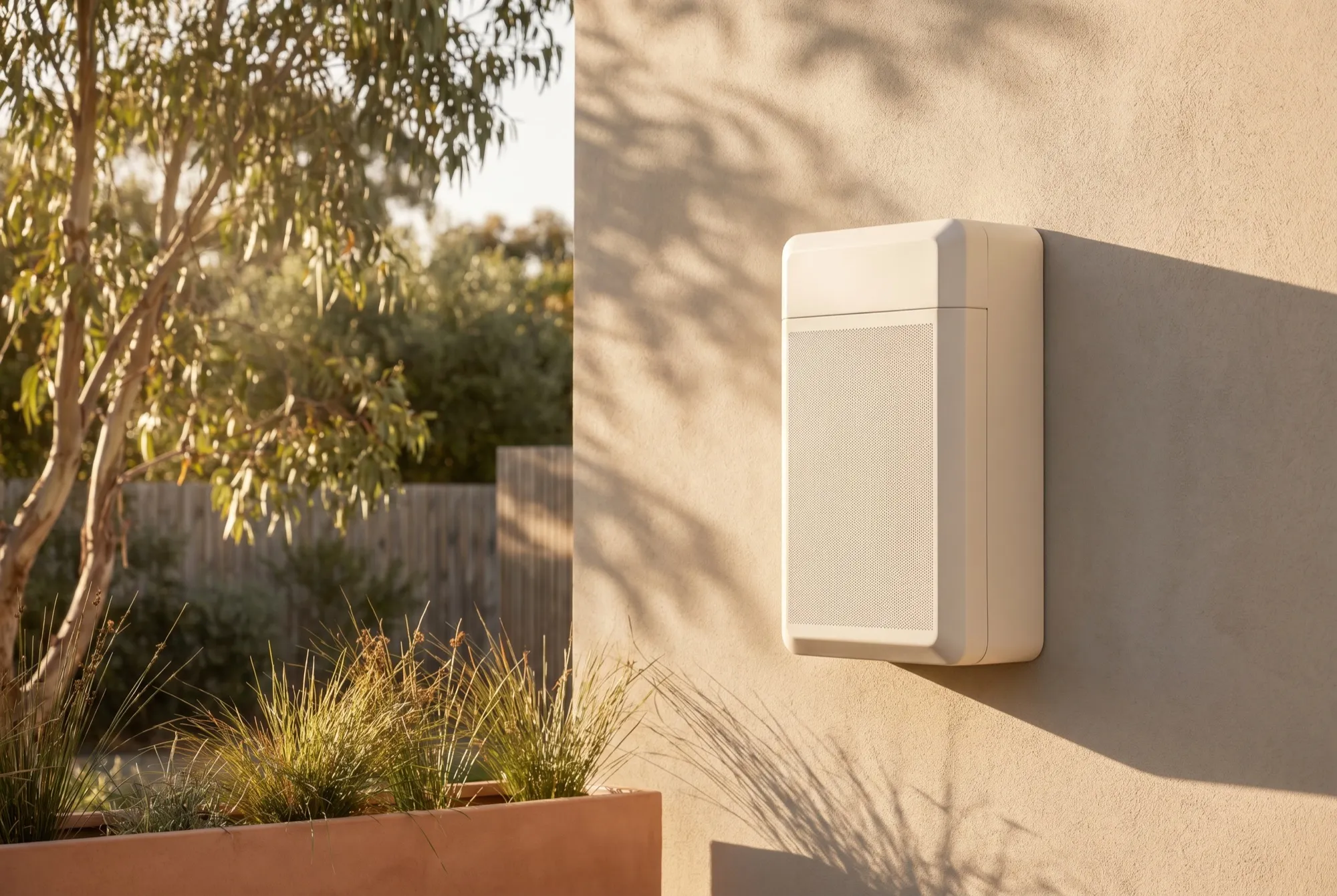
The short answer, for a typical Australian home in 2026: a fully installed solar battery costs roughly $8,000 to $13,000 before rebates for a 10 to 13.5 kilowatt-hour system, and the federal battery rebate takes about 30 per cent off that at the point of sale. Most households end up paying somewhere between $6,500 and $9,500 for a 10kWh battery fitted to an existing solar system.
That is the headline. The detail is where the money is won or lost.
Price by battery size
Battery pricing in Australia is quoted per usable kilowatt-hour of storage. The installed rate, including the inverter work and the electrician’s sign-off, has settled to roughly $900 to $1,300 per usable kWh before rebate in 2026, down from well above $1,500 only a few years ago. The federal rebate then discounts that.
| Usable size | Typical installed price (before rebate) | After the federal battery rebate | Suits |
|---|---|---|---|
| 5 kWh | $5,500 to $7,500 | $4,000 to $5,500 | Smaller homes, topping up daytime solar |
| 10 kWh | $9,000 to $13,000 | $6,500 to $9,500 | A typical three to four person home |
| 13.5 kWh | $12,000 to $16,000 | $8,500 to $12,000 | High evening use, or a home charging an EV |
These are installed ranges for a battery added to an existing rooftop solar system, last checked June 2026. A battery bought as part of a new solar install is often a little cheaper per kWh because the inverter and switchboard work is shared. Backup capability, meaning the battery keeps your lights on in a blackout, typically adds $1,000 to $2,000 because it needs extra wiring and a changeover device.
How the federal rebate works
The Cheaper Home Batteries Program took effect on 1 July 2025. It discounts the installed cost of a home battery by approximately 30 per cent, delivered as a point-of-sale discount on the installer’s invoice rather than a reimbursement you claim back later. In 2025 that was worth around $330 per usable kilowatt-hour, and the program scales down each year until it winds up in 2030.
Two things matter for your wallet. First, because the discount is per usable kWh, a bigger battery captures a bigger rebate, up to the program’s cap. Second, because the subsidy falls each year, the dollar value of waiting is real: the same battery is cheapest, in rebate terms, the earlier in the program you install it.
The rebate runs through the same Small-scale Renewable Energy Scheme machinery that has underwritten Australian rooftop solar since 2011, so any accredited installer can apply it for you. You should see it itemised on the quote. If it is not, ask why before you sign. The quickest way to see what you personally qualify for is a postcode-based estimate; My Home Battery runs a free calculator that stacks the federal rebate with whatever your state is offering.
State incentives stack on top
The federal rebate is the floor, not the ceiling. State and territory schemes stack on top, and they change often:
- NSW runs a battery incentive through the Peak Demand Reduction Scheme.
- Victoria has offered an interest-free battery loan through Solar Victoria.
- Western Australia runs a Residential Battery Scheme with Synergy and Horizon tiers.
- South Australia’s original Home Battery Scheme has wound down and is not taking new applications.
Because these move around, the only number that matters is the one for your postcode this month. Treat any flat “batteries cost $X” figure with suspicion: it is almost always quoting a different state, a different year, or a different rebate.
When does it pay back?
This is the question the price tag does not answer. A battery’s payback depends on three things the brochure rarely leads with: how much power you use after dark, what your retailer pays you for exported solar (the feed-in tariff, now often just a few cents), and how often your area loses grid power.
A home battery in Australia typically pays for itself in seven to twelve years on energy savings alone. The households at the fast end of that range are the ones using most of their power in the evening, on a low feed-in tariff, after the rebate.
If you export most of your solar for two or three cents a kilowatt-hour and then buy it back at thirty-something cents after sunset, a battery closes that gap, and the gap is the whole case. If you are out all day and use most of your power at night, the numbers are good. If your home runs mostly on daytime solar already, a battery is more about backup and independence than payback.
What actually drives the final price
Two quotes for “a 10kWh battery” can differ by thousands. The drivers, in order:
- Backup or no backup. Blackout protection adds wiring and a changeover device.
- Single phase versus three phase. Three-phase homes need compatible hardware.
- Switchboard condition. An older board may need an upgrade to meet current standards.
- Brand and chemistry. Lithium iron phosphate (LFP) is now the safe default; premium brands carry a premium price, not always a premium outcome.
- Installer longevity. The cheapest quote from a one-year-old company is not a saving if the warranty outlives the company.
That last point is the one that quietly costs Australians the most. More than 700 solar retailers have left the market since 2011, and roughly one in six installed systems now carries a warranty against a company that no longer trades. The fix is boring and effective: choose an installer with several years of continuous trading and a verifiable company structure. Matching services such as Why Solar pre-screen installers on exactly that basis, which is worth more over a ten-year warranty than a few hundred dollars off on day one.
The bottom line
In 2026, a home battery is cheaper to buy than it has ever been in Australia, the rebate is the largest it will be for the rest of the decade, and the payback maths works for any household with meaningful evening usage and a low feed-in tariff. Get a quote with the rebate itemised, check the installer’s trading history before the price, and run your own postcode through a rebate calculator so you know the real number before anyone calls you.
The battery that disappoints is rarely the one that cost a little more. It is the one bought on a price that hid the rebate, the backup, or the installer.