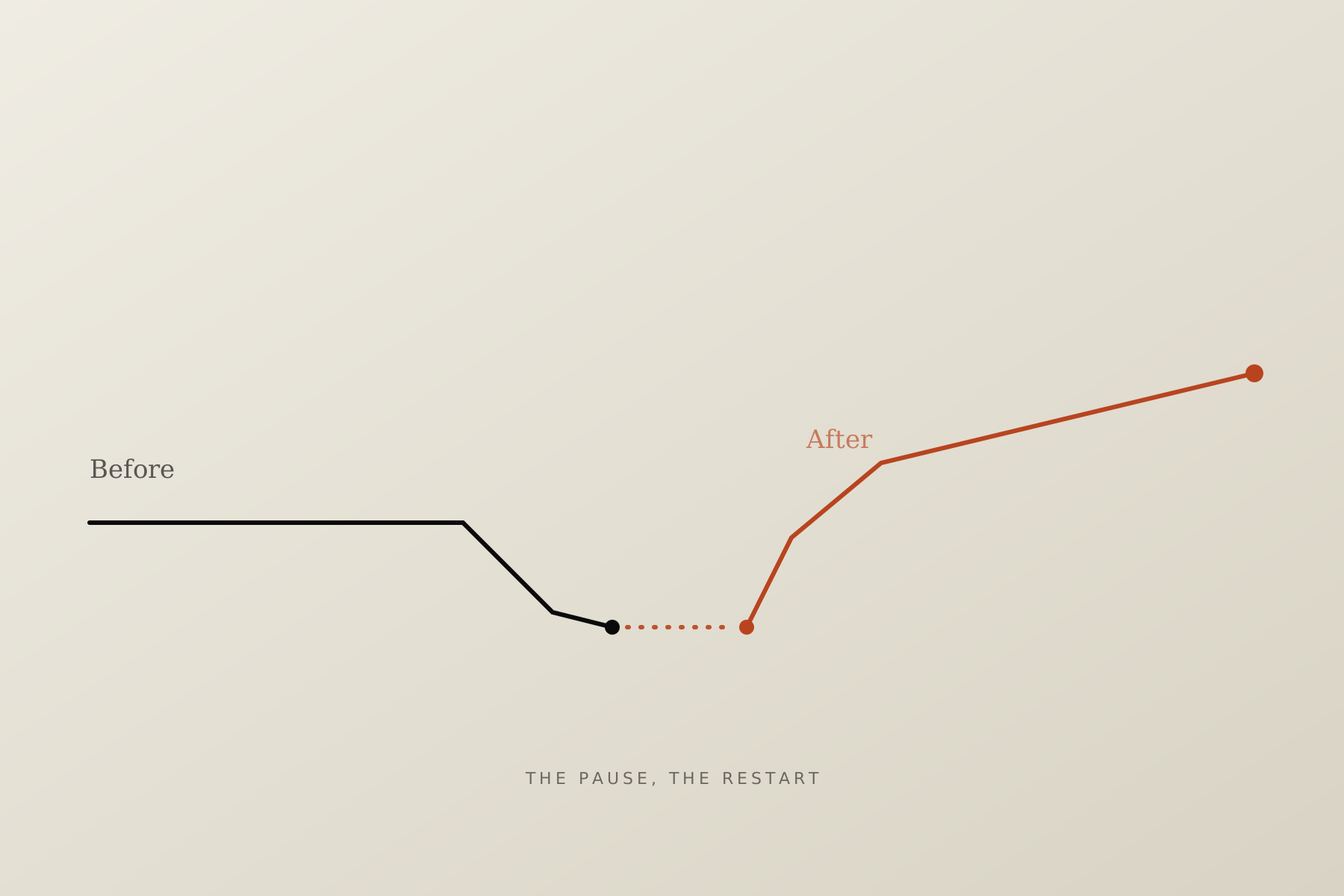
The 2023-24 wave of Australian small-business closures was well-covered. The quieter 2025-26 story is what is happening to the operators who closed.
ASIC’s FY25 insolvency statistics recorded more than 14,000 companies entering external administration, a record. ASBFEO’s 2024-25 annual report on small-business entries, exits and re-entries documents something underneath that record. A non-trivial share of the operators who exited are re-entering, in a different form, within 18 to 24 months of the closure.
The term “restart” is less clinical than “entering external administration and reopening after a restructuring process,” but the three distinct patterns I have seen operators follow all live under it. They are worth recording.
Pattern one: the SBR route
The Small Business Restructuring process (SBR), introduced in 2021 for companies with liabilities under $1 million, has had uneven uptake. Through 2024 and 2025 the uptake has risen sharply. The SBR process allows a director to remain in control of the company while a restructuring practitioner helps negotiate a plan with creditors. Where accepted, the plan typically writes off some portion of unsecured debt and gives the company a path to trade through.
For the right kind of business (positive operating margin, manageable non-ATO liabilities, viable forward order book), SBR has become the structurally cheaper restart pathway than liquidation plus re-formation. The advisers I have spoken to through 2025-26 are clear about the conditions: it works for the businesses whose underlying economics were sound before a specific shock (typically a tax-debt backlog). It does not work for the businesses whose underlying economics were not.
Pattern two: the format change
The most-visible 2025-26 restart pattern in hospitality and retail is the format change. A CBD dine-in restaurant closes, and the same operator reopens 18 months later as a suburban dine-in half the size with a bottle-shop attached. A CBD fashion boutique closes and reopens as a by-appointment showroom in the operator’s neighbourhood.
The specifics differ by sector. The common logic is the same. The closed business had a cost structure (rent, staff, suppliers) that did not work at the revenue level of the market it was operating in. The restart business has a cost structure that does, for a smaller but more loyal customer base.
The best-documented 2025-26 case studies (via Broadsheet, Good Food, and local press in Sydney, Melbourne and Brisbane) all show the same pattern. The operator did not lose the customers. They lost the cost base, kept the brand, kept a core of the team, and reopened.
Pattern three: the geography shift
Less visible but increasingly common in regional Australia is the geography shift. An operator who ran in a capital city closes, moves to a regional centre, and reopens there. The cost base (lease, staffing, utilities) is materially lower. The revenue ceiling is lower too, but often not by as much as the cost reduction.
This pattern is particularly visible in food service, professional services and small-scale manufacturing. The regional centres picking up most of the 2025-26 relocators are the ones with established lifestyle attractors for the 30-to-50 age cohort: Hobart, Newcastle, Byron Shire and the Sunshine Coast.
The venue I ran in 2022 could not, on the lease I signed, ever have made money. The venue I run now is a quarter of the size and makes money every week. The customers did not cause the closure. The lease did.
The restart playbook, compressed
Four moves repeat across the restarts I have documented.
- Shed the lease. Most closures are triggered by a lease that was right in 2019, wrong in 2023, and unsustainable in 2025. The restart starts with a lease that is sized to 2026 rather than to 2019.
- Shrink the footprint. Seats, SKUs, opening hours, service counters. Fewer of each, more tightly operated, with a tighter connection to the revenue per square metre of the smaller footprint.
- Keep the brand and the team. The customer loyalty attached to the name and the faces is the one operating asset the closure cannot destroy. Every successful restart I have seen has kept both.
- Renegotiate supplier terms from a clean slate. Closure, for better or worse, resets supplier relationships. The restart is the moment to negotiate new terms without the baggage of the old debts.
None of these is glamorous. All of them are what the operators I respect most have done.
The legal layer
For an operator considering a restart, two legal points are worth being clear on.
First, the ASIC director disqualification and the Corporations Act phoenix provisions mean that the same director cannot, as a matter of course, run the same company through the closure and reopen it as a new entity without navigating the phoenix framework carefully. The restart pathways most consistent with the law are SBR (preserves the entity), voluntary administration with a deed of company arrangement, or liquidation followed by re-formation at arm’s length from the old entity with legitimate commercial justification.
Second, the 2024 Phoenix Taskforce enforcement has focused on precisely the cases where the legal structure is used to transfer assets out of a creditor-facing company and into a debt-free one. Operators need legal advice before, not after, the restart.
The closure is not the failure. The failure is the closure that does not, because of hesitation or lack of information, become the restart. For the 2023-24 cohort that is still deciding, the window for a 2026 restart is the twelve months ahead of them. The operators who take it will mostly be the ones you do not yet know about. They will be back.