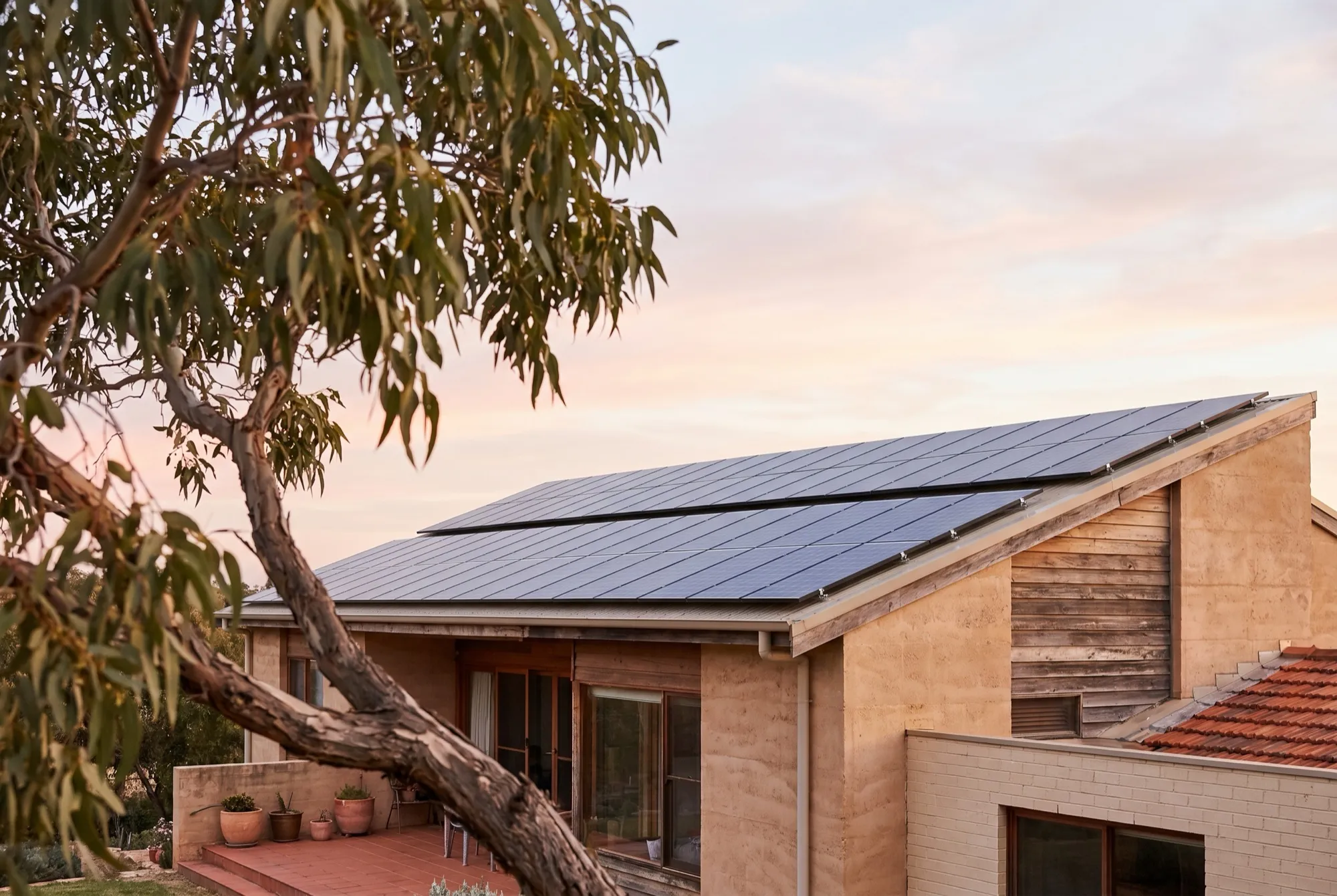
The short version for Western Australia in 2026: a 6.6kW rooftop system in Perth typically lands around $5,000 to $9,000 installed after the federal panel rebate, and on top of that WA runs its own Residential Battery Scheme that can stack with the national battery discount. Add some of the strongest sunshine in the country, and the payback case for solar in WA is about as good as it gets in Australia.
That is the headline. The detail is where WA gets interesting, because the state plays by its own rules on feed-in payments and export limits, and those rules change the numbers in ways a quote from the eastern states will not warn you about. These figures were last checked June 2026, and WA schemes move, so confirm the current status with Synergy, Horizon Power and the WA Government before you sign anything.
What a system costs in WA in 2026
Start with the panels. The federal Small-scale Technology Certificate (STC) rebate is the discount that makes rooftop solar cheap everywhere in Australia, and it is applied at the point of sale by your installer. On a 6.6kW system it was worth roughly $2,200 to $2,800 in 2025, and it steps down a little each year until the scheme ends in 2030. Perth sits in a strong solar zone, so the same panels generate slightly more certificate value here than in cooler southern capitals.
After that discount comes off, a quality 6.6kW system runs about $5,000 to $9,000 installed in 2026. The spread is wide because it covers everything from entry-level gear to premium panels and inverters, plus the cost of a tricky roof or a switchboard upgrade. If a quote comes in dramatically under that range, ask what is being left out.
Batteries are the other half of the conversation in WA, and they have their own rebate stack, which we will get to.
The battery rebates: federal plus a WA top-up
Since 1 July 2025 the federal Cheaper Home Batteries Program has knocked roughly 30 per cent off the installed price of a home battery, worth around $330 per usable kWh in 2025 and winding down each year to 2030. Like the panel rebate, it runs through the Small-scale Renewable Energy Scheme and is applied upfront, so you should see it itemised on the quote rather than claiming it yourself.
Here is the WA-specific part. Western Australia runs its own Residential Battery Scheme with two tiers, split by which network you sit on: Synergy customers in the South West Interconnected System, which covers Perth and the populated south-west, and Horizon Power customers across regional WA. The state scheme is designed to stack on top of the federal battery discount, which can make storage meaningfully cheaper in WA than the national figure alone suggests.
As a rough national benchmark, a 10kWh battery sits around $6,500 to $9,500 after the federal rebate. A WA buyer who also qualifies for the state scheme could pay less again, but the exact amount, the eligibility rules and the loan or rebate structure are exactly the sort of thing WA tweaks, so treat any number you read as a starting point and confirm the live terms with Synergy or Horizon Power directly.
DEBS: why WA’s feed-in maths is different
This is the part most eastern-states guides get wrong for WA. Western Australia does not pay a flat feed-in tariff. Instead it runs the Distributed Energy Buyback Scheme, or DEBS, which pays a time-varying rate for the power you export: more in the evening peak, less in the middle of the day when everyone’s panels are flooding the grid at once.
That single design choice changes the whole battery argument. Under a flat tariff, exporting midday sun is worth the same as exporting at 6pm. Under DEBS it is not even close, so the value of storing your cheap midday surplus and either using it or exporting it during the higher-rate evening window goes up.
Under a time-varying buyback like DEBS, a battery is not just about backup, it is about shifting your own sunshine from the cheap part of the day to the valuable part.
In plain terms: in WA the buyback rewards evening export, so self-consumption and storage tend to look better than they would under a flat rate. If you are weighing storage, our guide to solar battery cost in Australia walks through the payback logic, and our explainer on the solar feed-in tariff in Australia covers how buyback rates have fallen nationally and why exporting is no longer the prize it once was.
Export limits: the catch nobody mentions
One more WA wrinkle. Many WA networks now impose export limits on new solar systems, capping how much power you are allowed to push back to the grid. The cap exists because there is so much rooftop solar feeding in at midday that the local network can only absorb so much.
The practical effect is that oversizing your panels purely to sell more midday power can hit a ceiling that makes the extra capacity less useful than the brochure implies. It is another reason the WA equation leans towards using your own generation, through self-consumption and storage, rather than banking on big export earnings. A good local installer will know the export rules for your specific feeder, which is not something a national sales team can tell you.
How the WA numbers stack up
Here is the rough shape of it for 2026, last checked June 2026. Every figure is a guide, not a quote, and WA schemes change.
| Item | Indicative figure (2026) | Notes |
|---|---|---|
| 6.6kW system, installed | ~$5,000 to $9,000 | After the federal STC rebate, which is applied at sale |
| Federal STC rebate (6.6kW) | ~$2,200 to $2,800 | Steps down yearly to 2030 |
| 10kWh battery, installed | ~$6,500 to $9,500 | After the federal battery rebate; WA scheme may reduce further |
| Federal battery rebate | ~30%, about $330/kWh | Cheaper Home Batteries Program, winding down to 2030 |
| WA Residential Battery Scheme | Varies by tier | Synergy or Horizon Power; can stack with the federal rebate |
| Feed-in (DEBS) | Time-varying | Higher in the evening peak, lower midday |
For the national picture behind these state figures, our full breakdown of solar rebates in Australia explains how the federal layers work and why each one shrinks the longer you wait.
Why the installer matters more than the brochure
A quick reality check that applies everywhere, WA included. More than 700 solar retailers have gone under in Australia since 2011, and roughly one in six systems is now effectively orphaned, meaning the company that installed it no longer exists to honour the warranty. A ten-year workmanship warranty is only as good as the business standing behind it.
In WA this matters twice over, because the network rules, the export limits and the DEBS arrangement are all local. You want an accredited installer who works in WA every week and knows your specific network, not a call centre interstate. Comparison and review services such as Why Solar can help you find an accredited WA installer who actually understands the local network rules, rather than picking the cheapest quote and hoping.
The bottom line
Perth and WA are close to the best place in the country to put solar on a roof. The sunshine is strong, the federal panel and battery rebates apply just as they do everywhere, and WA adds its own Residential Battery Scheme on top through Synergy or Horizon Power. A 6.6kW system around $5,000 to $9,000 after the panel rebate, with a battery that may qualify for two layers of discount, is a genuinely good deal in 2026.
The catches are local. DEBS pays a time-varying buyback rather than a flat rate, which pushes the value towards self-consumption and storage, and many networks now cap your exports. Both reward using your own power over selling it. Get a couple of quotes from accredited WA installers, ask them to model the numbers on DEBS and your network’s export limit rather than a flat tariff, and confirm the current rebate status with Synergy, Horizon Power and the WA Government before you commit, because these schemes do not stand still.