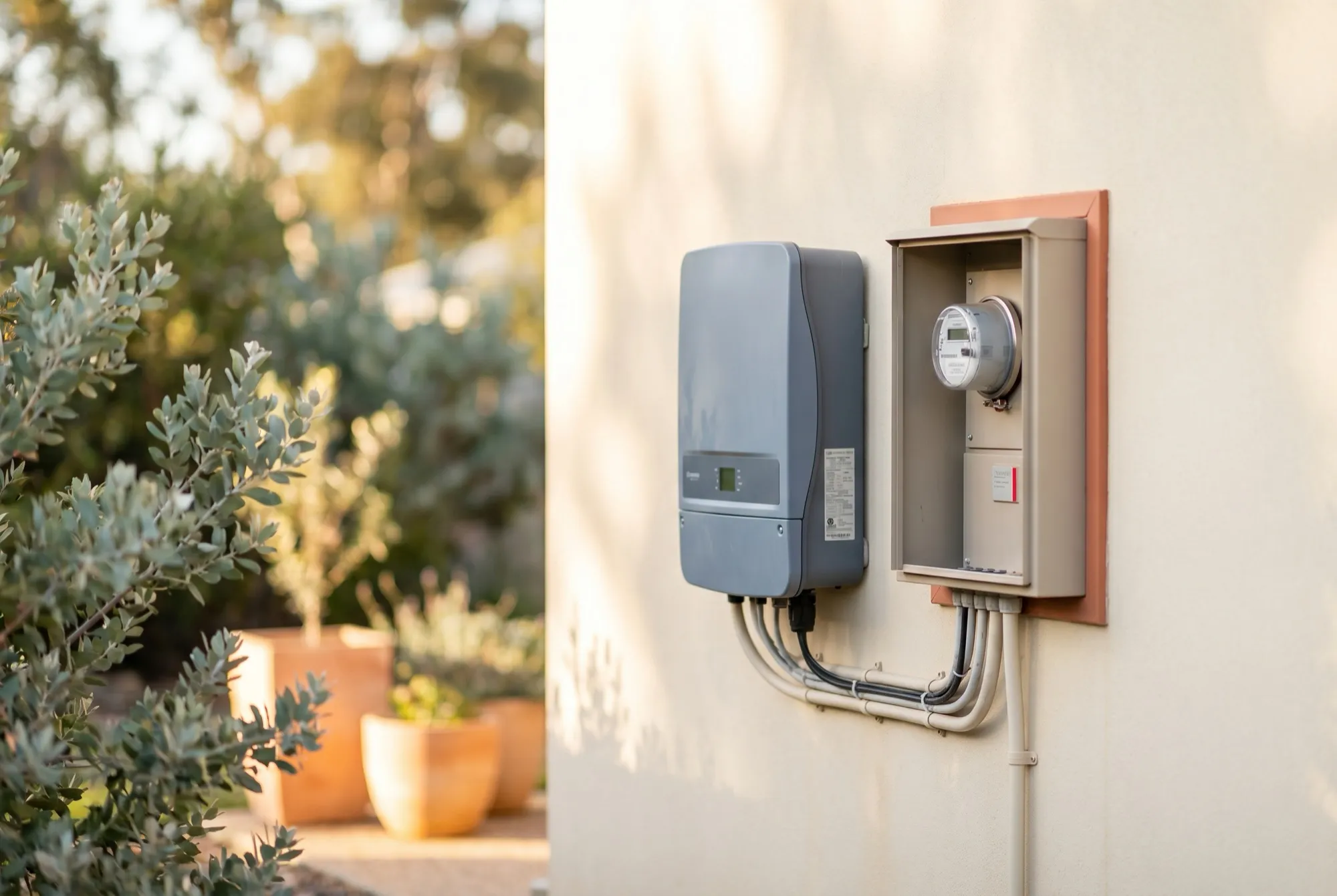
The short answer for 2026: there is no single “solar rebate” in Australia, there is a stack of them. A 6.6kW rooftop panel system attracts a federal discount worth roughly $2,200 to $2,800 this year, a home battery attracts a separate federal discount of about 30 per cent off the installed price, and most states layer their own incentive on top of both. Your installer applies the federal ones at the point of sale, so the price you are quoted should already include them.
That is the whole game in one paragraph. The rest is about who qualifies for what, how much each layer is worth in 2026, and why every figure here is quietly falling each year you put it off.
The three layers of the Australian solar rebate
It helps to stop thinking of “the solar rebate” as one thing. In 2026 there are three distinct mechanisms, and they do not all work the same way.
- The federal STC rebate discounts the panels. It has run since 2011 and is the reason rooftop solar is cheap in Australia at all.
- The federal Cheaper Home Batteries Program discounts the battery. Live since 1 July 2025, it is the big change for anyone weighing up storage.
- State and territory schemes sit on top of both, and they move around constantly.
The two federal layers share the same plumbing. Both are delivered through the Small-scale Renewable Energy Scheme, the certificate market that has underwritten Australian solar for well over a decade. The practical upshot is that an accredited installer claims the certificates and passes the value through as an upfront discount. You do not fill in a form or wait months for a cheque. You simply see a smaller, itemised number on the quote.
Layer one: the STC rebate on panels
The panel rebate is officially the creation and sale of Small-scale Technology Certificates, or STCs. Every eligible system generates a batch of certificates based on its size, your location, and how many years remain until the scheme ends. Your installer sells them and knocks the proceeds straight off your invoice.
For a standard 6.6kW system, the STC support is worth roughly $2,200 to $2,800 in 2026, depending on your zone. Sunnier zones in Queensland, the Northern Territory and inland New South Wales generate more certificates than cooler southern postcodes, so the same panels earn a slightly larger discount in Townsville than in Hobart. These ranges were last checked June 2026.
Here is the catch worth internalising. The number of certificates a system generates is “deemed” based on the years left until the scheme winds up on 31 December 2030. Every year that passes, there are fewer years left to deem, so the same system generates fewer certificates and earns a smaller rebate. The decline is gradual rather than a cliff, but it is real and it is written into the legislation.
Layer two: the Cheaper Home Batteries Program
This is the one that changed the conversation. The Cheaper Home Batteries Program went live on 1 July 2025 and cuts the installed cost of a home battery by approximately 30 per cent. In 2025 that worked out to around $330 per usable kilowatt-hour, applied, like the panel rebate, as a point-of-sale discount rather than a rebate you claim back later.
Because the discount is calculated per usable kWh, a bigger battery captures a bigger rebate, up to the program’s cap. A typical 10kWh battery that lists at $9,000 to $13,000 installed before the rebate generally lands somewhere around $6,500 to $9,500 after it, fitted to an existing solar system. We unpack those size-by-size figures in detail in how much a solar battery costs if you want the full pricing table.
Does it pay to wait?
Both federal rebates shrink a little every year. The cheapest version of any system, in rebate terms, is almost always the one you install sooner rather than later.
Like the STC scheme, this program scales down annually and is legislated to wind up around 2030, so the dollar value of the discount is largest the earlier you act. For the finer detail on eligibility, battery requirements and how the discount is calculated, see our explainer on the Cheaper Home Batteries Program.
Layer three: state and territory schemes
On top of the two federal layers, most states and territories run their own incentive. These move often, open and close without much warning, and frequently depend on your income, your retailer or your exact postcode. Treat the table below as a starting point for 2026, not gospel, and always check your own postcode before you sign anything.
| State or territory | What is on offer in 2026 | Notes |
|---|---|---|
| New South Wales | Peak Demand Reduction Scheme battery incentive | Aimed at batteries that can shave grid peaks; value varies by installer and capacity |
| Victoria | Solar Victoria interest-free battery loan | A loan rather than a cash rebate; spreads the upfront cost rather than cutting it |
| Western Australia | Residential Battery Scheme | Tiered by network, with separate Synergy and Horizon Power offers |
| South Australia | Home Battery Scheme | Wound down and no longer taking new applications |
| Queensland, ACT, Tasmania, NT | Programs come and go | Check the relevant state energy department for current offers |
The headline for New South Wales readers searching for a “solar rebate NSW”: your stack is the federal STC discount on panels, the federal battery discount on storage, and the state Peak Demand Reduction Scheme incentive on a qualifying battery. All three can apply to the one project. South Australia is the cautionary tale at the other end: its once-generous Home Battery Scheme has closed to new applicants, which is exactly why you cannot assume a scheme that ran last year still runs.
How the rebates actually reach you
For both federal layers, the rule is worth repeating: the installer applies them at the point of sale. You are not chasing a government rebate after the fact. If a quote does not itemise the STC discount and, for a battery, the Cheaper Home Batteries discount, ask why before you sign.
State schemes are the exception and vary in form. Some are upfront discounts handled by the installer, some are loans, and a few still require a separate application. Read the fine print for your state.
The risk nobody quotes you on
There is a catch that does not appear on any invoice. More than 700 Australian solar retailers have exited the market since 2011, and by some estimates roughly one system in six carries a warranty against a company that no longer trades. A rebate makes the upfront price look great, but it does nothing for you if the installer has vanished by the time a panel or inverter fails.
The mitigation is unglamorous but effective. Favour an installer with several years of continuous trading, a verifiable ASIC-registered business structure, and accreditation to claim the rebates properly. As a starting point, Why Solar matches households with vetted, long-trading installers who apply the federal rebates correctly rather than quietly pocketing the certificate value. The cheapest quote and the safest quote are not always the same document.
A quick word on feed-in tariffs
One thing that is not a rebate, and is often confused for one, is the feed-in tariff: the few cents your retailer pays for surplus solar you export to the grid, now typically around 3 to 8 cents per kWh in 2026, well below the 30 cents or more you pay to import power. The economics have flipped accordingly, and that is precisely why batteries and the battery rebate have become the centre of gravity.
The bottom line
There is no one solar rebate in Australia in 2026, there is a stack: roughly $2,200 to $2,800 off a 6.6kW panel system through the STC scheme, about 30 per cent off a battery through the Cheaper Home Batteries Program, and a shifting set of state incentives on top. The two federal layers are applied by your installer at the point of sale, so a proper quote should already show them itemised. Every layer is on a timer counting down toward 2030, so the rebates are generous now and quietly less so each year. Get a postcode-specific quote, stack all three layers, and pick an installer likely to still be trading when you need them. The rebate is the easy part. The durable installer is the part that actually protects the money.